1 Ducat Austrian Gold Coin — Franz Joseph I Restrike
1 Austrian Ducat Gold Coin is one of the most recognised and historically significant gold coins in Europe. Struck by Münze Österreich — the Austrian Mint located in the Wieden district of Vienna — it brings together four centuries of ducat tradition, the portrait of the last great Habsburg ruler, and gold of 986/1000 fineness (23.75 carat) in a precisely struck disc weighing 3.4909 g. All contemporary pieces bear the date 1915 — the year of the last original circulation issue — and are an official restrike of Münze Österreich, produced continuously since 1920.
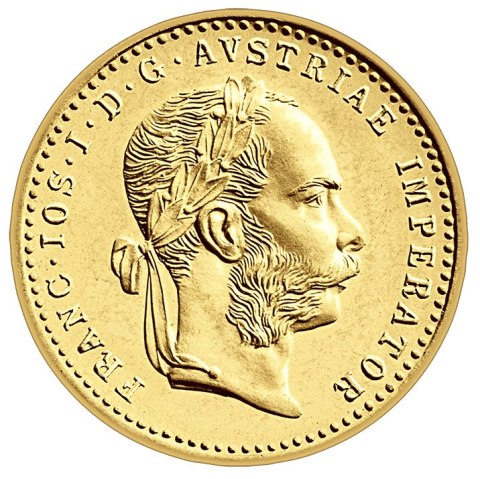
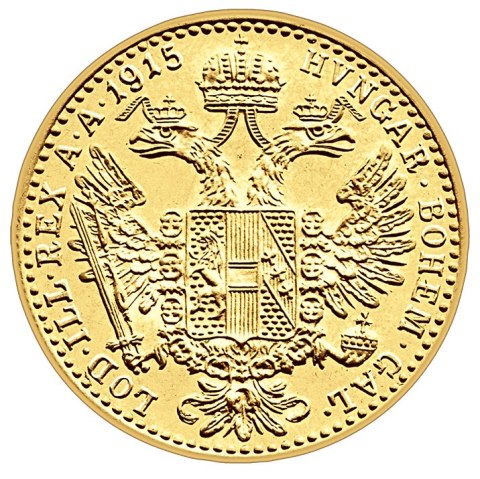
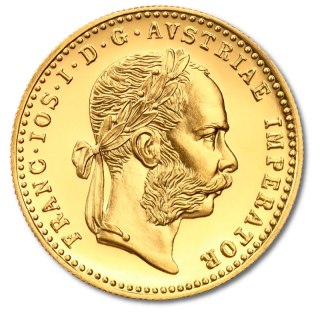
The obverse features the right-facing portrait of Emperor Franz Joseph I (1830-1916), who ruled for 68 years and became the defining symbol of his era. The reverse carries the Habsburg double-headed eagle — the heraldic emblem of the dynasty and empire — surrounded by a Latin legend listing all the monarch's titles. For over a century, this coin has attracted collectors, physical gold holders, and enthusiasts of Central European history alike.
1 Austrian Ducat is available from GoldInvest24 as a non-circulation restrike of Münze Österreich — produced to the original specification of the Austro-Hungarian era. Its small weight and outstanding history make it one of the most accessible entry points to the European historical gold market.
History of the Austrian ducat — from 1612 to the present day
The Austrian gold ducat has roots reaching deep into the Middle Ages. As a European gold coin, the ducat first appeared in Venice in the 13th century and quickly spread across the continent. On Habsburg territory the first ducat issue is dated to 1612, during the reign of Emperor Matthias II. Over the following centuries the ducat in various iterations was the official means of payment of the empire, travelling through wars, treaties and trade routes of Europe, accumulated by merchants, rulers and citizens as an immutable store of value.
The form known today as the 1 Ducat of Franz Joseph I was struck as a fully-fledged Austro-Hungarian circulation coin from 1872 to 1915, accepted across the empire and beyond its borders. After the death of Franz Joseph in 1916 and the dissolution of Austria-Hungary in 1918, Münze Österreich decided to continue striking this coin as a non-circulation restrike (Nachprägung), retaining the original date 1915, the same design, gold fineness and dimensions. The restrike began in 1920 and continues to this day; the total number of pieces struck since then runs into the millions.
The retention of the date 1915 is deliberate — a conscious mark of respect for mint tradition and a clear way to distinguish the restrike from original circulation pieces from various years of the emperor's reign. Each contemporary piece is therefore both a product of 21st-century Münze Österreich and a literal reproduction of a coin from the Habsburg era.
Price of the 1 Austrian Ducat
The price of the 1 Austrian Ducat is determined primarily by the current gold spot price on world markets. With a total weight of 3.4909 g and a fineness of 986/1000, the coin contains precisely 3.4421 g of fine gold (0.1106 troy ounces). The purchase price consists of the gold value calculated from the current spot rate plus a dealer premium which, for small historical coins, tends to be somewhat higher than for large 1 oz bullion coins, owing to the characteristics of small fractions and higher production costs per gram of gold.
To assess the right moment to buy and to track current quotations, it is worth regularly consulting the precious metals prices and charts available at GoldInvest24. Comparing the ducat's price against the gold spot rate allows buyers to make informed decisions when building their physical gold holdings.
Why physical gold in the form of historical coins?
Physical gold has served as a store of value for thousands of years — an asset independent of banking systems, recognised globally and free from counterparty risk. Historical gold coins such as the Austrian Ducat combine the precious metal's intrinsic value with a unique historical narrative and aesthetic that has always attracted numismatists, collectors and those accumulating physical gold for long-term capital preservation alike. Unlike paper gold instruments, you hold genuine tangible value.
The Austrian Ducat is also notable for its exceptionally low entry threshold among gold coins with precious metal content — its small weight and accessible price allow gradual building of a physical gold collection without requiring the outlay of a full ounce at once. If you are also interested in other products from this segment, GoldInvest24 offers a wide selection of gold bullion coins from renowned mints across the globe.
Obverse — portrait of Emperor Franz Joseph I
The obverse of the 1 Austrian Ducat shows the right-facing profile of Emperor Franz Joseph I — Franz Joseph Charles, Emperor of Austria, King of Hungary, Bohemia, Galicia, Lodomeria and Illyria, Archduke of Austria, reigning from 1848 to 1916. On the emperor's head is a laurel wreath (corona laurea) — a reference to ancient imperial tradition. The bust is rendered in right-facing profile, in accordance with monarchical iconographic convention.
Encircling the portrait is the Latin legend: "FRANC IOS I D G AVSTRIAE IMPERATOR" — in full: Franciscus Iosephus I Dei Gratia Austriae Imperator, meaning "Franz Joseph I by the Grace of God Emperor of Austria". This legend, present on circulation ducats from the years 1872-1915, remained unchanged on all restrike pieces — identical lettering, identical abbreviations, identical graphic layout. Franz Joseph I reigned for 68 years and was one of the longest-serving monarchs in European history — his portrait on the ducat forms a direct, physical link with centuries of Habsburg history.
Reverse — the Habsburg double-headed eagle
The reverse of the coin is dominated by the Habsburg double-headed eagle — one of the most recognisable heraldic emblems in European history. The eagle with spread wings, two heads turned in opposite directions and an imperial crown above both heads holds in its talons an orb and sceptre — symbols of dominion and the unity of the empire. On the eagle's breast is the Austrian shield — the red-white-red coat of arms, one of the oldest family crests in Europe.
Surrounding the eagle is the legend: "HVNGAR BOHEM GAL LOD ILL REX A A 1915" — an abbreviation of the titles: Hungariae Bohemiae Galiciae Lodomeriae Illyriaeque Rex, Archidux Austriae — King of Hungary, Bohemia, Galicia, Lodomeria and Illyria, Archduke of Austria — 1915. The year 1915 is the nominal date of all contemporary restrikes. The double-headed eagle as the symbol of the Austro-Hungarian Empire was one of the most potent heraldic signs of the late 19th and early 20th century — its presence on this small gold coin gives the ducat an extraordinary historical charge.
What does "Restrike" mean?
A restrike (German: Nachprägung) is a coin struck by an official state mint to the original design and specification of a historic circulation issue, but without the status of legal tender. In the case of the Austrian Ducat, Münze Österreich strikes restrikes using original or faithfully reproduced dies, retaining the same gold fineness (986/1000), weight (3.4909 g), diameter (19.75 mm) and design on both sides — including the date 1915.
The restrike status does not diminish the coin's metal value — the gold content is completely identical to the original circulation issue from the Austro-Hungarian monarchy era. The restrike is an official, signed product of Münze Österreich — one of the oldest and most prestigious European mints, in existence since at least the 12th century and for centuries the principal coinage authority of the Habsburg Empire.
Is it worth buying the 1 Austrian Ducat?
The 1 Austrian Ducat is a product combining unique qualities: a tradition dating back to 1612, the portrait of one of Europe's most significant monarchs, the historic 986/1000 gold alloy, and a form issued by a renowned state mint. For those building physical gold holdings, the ducat is an excellent complement to larger units — each piece is a standalone, fully independent unit of gold with global recognition.
Its popularity extends far beyond Austria — in German-speaking countries (Austria, Germany, Switzerland) the Habsburg ducat is a classic gift for important family occasions and a symbol of enduring value. It is frequently the first step in building a historical gold collection owing to its low price threshold. The Austrian Ducat is not a speculative product — it is a historical precious metal piece whose value derives from its precious metal content and unique cultural standing.
Key benefits of purchase
- 986/1000 gold fineness (23.75 carat) — the historic Austrian ducat alloy,
- total weight 3.4909 g, including 3.4421 g fine gold (0.1106 oz),
- official restrike of Münze Österreich — one of Europe's oldest mints,
- Austrian ducat tradition dating back to 1612 — over four centuries of history,
- portrait of Emperor Franz Joseph I — the longest-reigning Habsburg monarch,
- nominal date 1915 — last year of circulation issue, restrike since 1920 continuously,
- small denomination — very low entry point for physical gold acquisition,
- classic gift in Austrian, German and Swiss culture,
- VAT exemption under EU Directive 2006/112/EC,
- high recognition and liquidity on the European secondary market.
Comparison of popular small historical gold coins (~3-4 g)
The table below presents the most frequently chosen small historical and bullion gold coins weighing approximately 3-4 grams, comparing their key parameters. The 1 Austrian Ducat stands out for its unique 986/1000 fineness and exceptional historical tradition reaching back to the 17th century.
| Coin |
Country of issue |
Gold fineness |
Total weight |
Diameter |
Notes |
| 1 Austrian Ducat (Restrike) |
Austria |
986 (23.75 ct) |
3.4909 g |
19.75 mm |
this product — restrike since 1920 |
| 4 Austrian Ducats (Restrike) |
Austria |
986 (23.75 ct) |
13.9638 g |
39.5 mm |
larger restrike variant |
| 10 Crowns Austro-Hungary (Franz Joseph) |
Austria-Hungary |
900 |
3.3875 g |
19 mm |
historic circulation coin |
| 20 Francs Napoleon III |
France |
900 |
6.4516 g |
21 mm |
19th-century French circulation coin |
| 1/10 oz Vienna Philharmonic |
Austria |
999.9 |
3.1103 g |
16 mm |
contemporary bullion coin |
FAQ — 1 Austrian Ducat Gold Coin
Is the 1 Austrian Ducat a historical or contemporary coin?
It is a coin with a historical design and contemporary production. The obverse motif (portrait of Franz Joseph I) and reverse motif (Habsburg double-headed eagle) originate from the original circulation issue of 1872-1915. However, pieces available today are an official restrike of Münze Österreich struck since 1920 — produced to the historical specification but without legal tender status. Each piece bears the nominal date 1915, though it may have been produced in any year after 1920.
What does "restrike" mean in the context of the Austrian Ducat?
A restrike means that the coin is struck by an official state mint to the original design of a historic circulation coin, but without legal tender status. Münze Österreich has been producing the Austrian Ducat as a restrike since 1920 — retaining the identical 986/1000 gold fineness, weight of 3.4909 g, diameter of 19.75 mm and nominal date of 1915. A restrike is a fully valued precious metal product intended for collecting and accumulating physical gold, not for monetary circulation.
Why do all pieces carry the date 1915?
The year 1915 is the date of the last original circulation issue of the Austrian Ducat under Emperor Franz Joseph I. After the emperor's death in 1916, Münze Österreich decided to retain this date on all subsequent restrikes — as a mark of tradition and a clear identifier. The year 1915 does not denote the year a particular piece was struck; it is an integral, unchanging element of the restrike pattern since 1920.
What is the gold fineness and how much fine gold does the Austrian Ducat contain?
The Austrian Ducat is struck from gold of 986/1000 fineness, equivalent to 23.75 carat — the traditional historic alloy for Austro-Hungarian ducats. The total weight of the coin is 3.4909 g, of which the fine gold content is 3.4421 g, corresponding to 0.1106 troy ounces. The 986 fineness is higher than the standard 22-carat gold (916.7/1000) used in, for example, Krugerrands or Britannias.
Is the Austrian Ducat exempt from VAT?
Yes. Under Article 122 of Council Directive 2006/112/EC on the common system of value added tax, the supply of investment gold is exempt from VAT. The Austrian Ducat meets all the conditions: fineness 986 ≥ 900, struck after 1800, was legal tender in Austria-Hungary, and its market value does not exceed 80% of its gold value. It is therefore purchased free of VAT — you pay only the metal value and the dealer premium.
Who was Emperor Franz Joseph I, whose portrait appears on the obverse?
Franz Joseph I (1830-1916) was Emperor of Austria and King of Hungary, reigning for 68 years — one of the longest-serving monarchs in European history. He acceded to the throne in 1848 at the age of 18 and ruled until his death in 1916. He was the last great Habsburg emperor, under whose rule Austria-Hungary became a multinational empire of more than 50 million subjects. His portrait appeared on banknotes, coins and postage stamps throughout the empire and remains one of the most recognisable faces of 19th and early 20th-century European history.
How can you identify a genuine Austrian Ducat?
A genuine Austrian Ducat — a Münze Österreich restrike — is characterised by precise striking with a sharp, clear relief on both sides. The weight is exactly 3.4909 g, diameter 19.75 mm, thickness 0.7 mm. Obverse: right-facing profile of Franz Joseph I with laurel wreath and the legend "FRANC IOS I D G AVSTRIAE IMPERATOR". Reverse: Habsburg double-headed eagle with the legend "HVNGAR BOHEM GAL LOD ILL REX A A 1915". Gold of 986 fineness displays a characteristic deep yellow lustre. In case of any doubt as to authenticity, the coin should be weighed and measured by a specialist.
Order the 1 Austrian Ducat Gold Coin — Franz Joseph I Restrike at GoldInvest24 — 3.4421 g of fine gold at 986/1000 fineness from Münze Österreich, four centuries of Habsburg ducat tradition enclosed in a coin disc of just under twenty millimetres in diameter.
Technical specification
| Parameter |
Value |
| Product name |
1 Austrian Ducat Gold Coin — Franz Joseph I Restrike |
| Metal |
Gold |
| Fineness |
986/1000 (23.75 carat) |
| Weight |
3.4909 g (0.1123 oz) |
| Fine gold content |
3.4421 g (0.1106 oz) |
| Diameter |
19.75 mm |
| Thickness |
0.7 mm |
| Face value |
none (non-circulation restrike) |
| Form |
Bullion coin (restrike) |
| Country of origin |
Austria |
| Manufacturer |
Münze Österreich (Austrian Mint), Wieden, Vienna |
| Nominal date |
1915 |
| Restrike since |
1920 (continuous production) |
| Packaging |
Protective capsule |
Under Article 122 of Council Directive 2006/112/EC on the common system of value added tax, the supply of investment gold is exempt from VAT. Investment gold within the meaning of this directive includes gold coins struck after 1800, with a fineness of at least 900/1000, which are or have been legal tender in their country of origin, and whose market value does not exceed 80% of the gold value. The 1 Austrian Ducat — Münze Österreich restrike — fulfils all these conditions: fineness 986/1000, struck after 1800, was legal tender in Austria-Hungary. It is therefore purchased free of VAT, meaning you pay only for the metal value and the dealer premium.