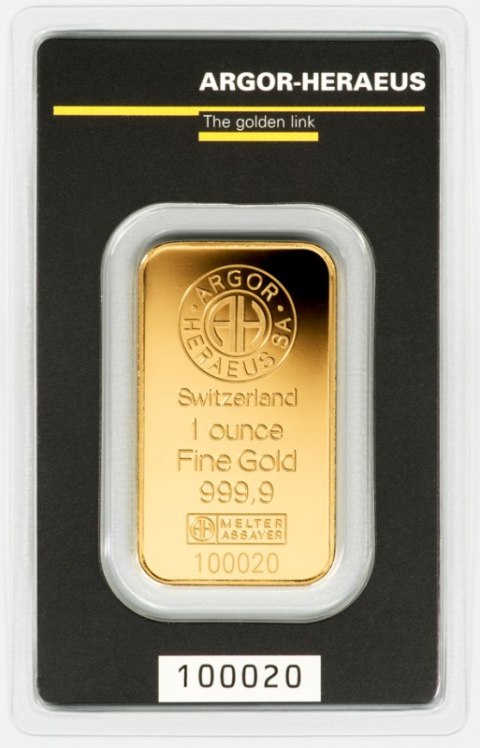
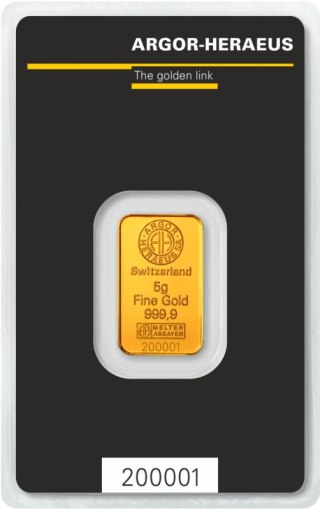
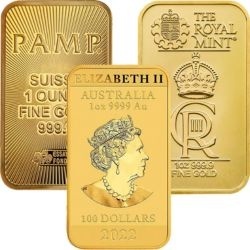
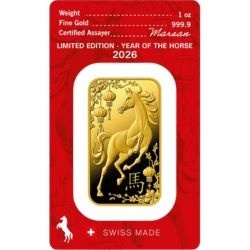
1 oz Argor-Heraeus gold bar — fruit of the 1999 fusion of two European refining traditions totaling 174 years of activity
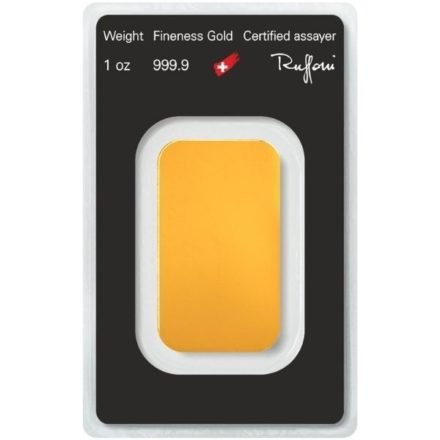
Argor-Heraeus is one of the five largest gold refineries in the world — a Swiss company formed in 1999 from the fusion of Swiss Argor SA (established 1951 in Chiasso) and German Heraeus Edelmetalle (established 1851 in Hanau, Hesse). The 1 oz variant contains 31.103 g of 999.9/1000 fineness pure gold in a rectangular bar with dimensions 41 × 24 × 1.85 mm. The bar is delivered in a factory CertiAssay card with KineGram hologram, unique serial number, refinery certificate and assayer signature.
The price of 1 oz Argor-Heraeus is linked to the current precious metal price at LBMA, with typical market premium of 3-5% over spot — in the same range as PAMP Fortuna (3-5%) and Valcambi (3-5%) in the premium 1 oz bar segment. Argor-Heraeus is the only classic bullion refinery with combined 174-year tradition (Heraeus 1851 + Argor 1951) — no other brand in the premium bullion market has comparable historical depth in precious metal refining technology.
Why 1 oz Argor-Heraeus gold bar?
- 31.103 g of 999.9/1000 fineness pure gold (.9999, 24 karat) — Swiss refinery standard
- Argor-Heraeus — 174 years of combined tradition (Heraeus 1851 + Argor 1951) — oldest combination in segment
- LBMA Good Delivery since 1999 (continuation of status of both predecessors) — Heraeus since 1928, Argor since 1986
- KineGram security feature (since 2018) — multispectral hologram changing color and image at angles
- Premium 3-5% over spot — in the premium 1 oz bullion bar segment
GoldInvest24 expert recommends — expert commentary
Heraeus is one of the oldest continuously operating precious metal refineries in Europe. Founded in 1851 in Hanau (Hesse, Germany) by Wilhelm Carl Heraeus, chemist and pharmacist, initially as a pharmacy with chemical laboratory for platinum refining. Heraeus was the first in Europe to develop the process of industrial platinum refining (1854) — this enabled Germany's independence from Russian dominance in platinum trade. In subsequent decades, Heraeus expanded activities to gold, silver, palladium and rhodium. In 1928, Heraeus Edelmetalle obtained LBMA Good Delivery status — as one of the first private refineries in the world (the London Bullion Market Association was only established in 1987, but Heraeus was recognized in the London Good Delivery system since the first decades of the 20th century).
Argor SA was established in 1951 in Chiasso (canton Ticino, Italian-speaking Switzerland) — very close to the Italian border. The location was strategic in the post-war period: Italy had large German gold reserves, but lacked domestic refineries meeting Good Delivery standards. Argor SA filled this gap — processed Italian gold and refinanced it in certified form. In 1986, Argor SA obtained LBMA Good Delivery status. The decision to merge with Heraeus Edelmetalle in 1999 had two motives: (1) consolidation of the premium bullion segment in Europe in the face of growing competition from the USA (Engelhard) and Asia (Tanaka), (2) joint use of technology (Heraeus had advantages in platinum and palladium, Argor — in gold). The new company moved its headquarters to Mendrisio (Switzerland) — between Chiasso and Lugano, close to the center of European precious metal trade.
The year 2018 brought the introduction of KineGram — a multispectral security hologram that changes color and image at various viewing angles (effect characteristic of banknotes). KineGram contains: (1) color change of the hologram between "silver" and "gold" at various angles, (2) micro-engraved logo "AH" visible only under 10× loupe, (3) unique 12-digit serial number synchronized with the Argor-Heraeus database, (4) image change between "A" and "H" (refinery initials) at angles. Argor-Heraeus investment in KineGram technology was a response to Chinese counterfeiting (developing since 2018) — the system is technologically comparable to CertiPAMP (PAMP 1996), though introduced 22 years later.
Argor-Heraeus — analysis of refining tradition and strategic position in the premium bullion segment
Among the five largest premium bullion refineries (PAMP 1977, Argor-Heraeus 1999/1951, Valcambi 1961, Heraeus standalone 1851, Tanaka 1885) — Argor-Heraeus is the only one with a fusion tradition combining two separate refining histories. PAMP: 48 years (1977-2025). Valcambi: 64 years (1961-2025). Heraeus standalone: 174 years (1851-2025) — but only in the platinum-palladium-silver segment. Argor-Heraeus inherits 174 years of Heraeus tradition in the gold segment — while maintaining the 74-year Argor identity.
Argor-Heraeus's strategic position in the premium bullion segment is stable and long-term. The refinery doesn't compete on price with the cheapest (Umicore, Heraeus standalone — premium 2.5-4%) nor on design with the most expressive (PAMP Lady Fortuna — premium 3-5% with artistic cost component). Instead, it positions itself as the "industry standard" — a bar that can be trusted in any transaction without specifying the particular refinery. European banks typically accept Argor-Heraeus bars as gold deposit without additional verification — a status that competitors must earn individually.
Practical implication for the EU investor: 1 oz Argor-Heraeus is mathematically equivalent to 1 oz PAMP Fortuna in metal value (both .9999, 31.103 g Au, premium 3-5%). The difference lies in: (a) graphic motif (PAMP has Lady Fortuna, Argor-Heraeus has logo + text — without decorative motif), (b) hologram (PAMP CertiPAMP since 1996, Argor-Heraeus KineGram since 2018), (c) mobile app (PAMP Veriscan 2024, Argor-Heraeus no mobile app). For clients prioritizing newest verification technology: PAMP Fortuna. For clients prioritizing oldest European tradition (174 years of fusion history): Argor-Heraeus.
What to consider when buying 1 oz Argor-Heraeus?
First: keep the factory CertiAssay card with KineGram hologram. A bar without the original card loses 1-3% of resale value (no serial number verification, no refinery certificate). Keep the card intact throughout the entire storage period. The KineGram hologram is delicate — don't wipe it, don't expose to extreme temperatures (>50°C).
Second: KineGram verifies manually, without mobile app. At 30° and 60° angles, the hologram should change color between "silver" and "gold" and alternately display the initials "A" and "H". Under 10× loupe, find micro-engraved logo "AH" in the hologram field. Missing any of these elements indicates counterfeit or hologram damage. Argor-Heraeus, unlike PAMP, doesn't offer a verification app — verification is "analog" with loupe and light.
Third: premium 3-5% — equal to PAMP Fortuna 1 oz. For pure bullion strategy, both bars are mathematically equivalent. The choice between PAMP and Argor-Heraeus depends on preference: tradition vs technology, artistic motif vs minimalist, mobile app vs manual verification. For a diversified portfolio, sensible mix: 50% PAMP + 50% Argor-Heraeus (both Swiss premium with different traditions).
Why GoldInvest24?
- Shipment of bars in original CertiAssay cards with KineGram hologram — full protection of refinery certificate
- Dynamic pricing linked to precious metal prices at LBMA, updated in real time
- Verification of KineGram hologram of every bar under professional lighting before shipment
- Secure courier shipment with full insurance and discreet packaging maintaining transaction anonymity
- Experienced GoldInvest24 expert team — we help select Argor-Heraeus vs PAMP vs Krugerrand proportion in bullion portfolio
Technical specification 1 oz Argor-Heraeus gold bar
| Parameter |
Value |
| Gold weight (Au) |
31.103 g (1.000 troy oz) |
| Fineness |
999.9/1000 (.9999, 24 karat) |
| Dimensions |
41 × 24 × 1.85 mm (rectangular) |
| Form |
Rolled bar |
| Producer |
Argor-Heraeus SA (Mendrisio, Switzerland) — fusion 1999 |
| Tradition |
Heraeus (1851, Hanau) + Argor (1951, Chiasso) — 174 years total |
| Packaging |
Factory CertiAssay card with KineGram hologram (since 2018) |
| Security features |
KineGram hologram (color + image A/H change) + micro-text "AH" + serial number |
| Verification |
Manual (10× loupe + light angle change) |
| Status |
LBMA Good Delivery (Argor since 1986, Heraeus since 1928) |
| Market premium |
3-5% over spot |
| VAT |
Exempt (Council Directive 98/80/EC across EU) |
1 oz Argor-Heraeus vs competition 1 oz gold bars
| Feature |
Argor-Heraeus 1 oz |
PAMP Fortuna 1 oz |
Valcambi 1 oz |
Heraeus 1 oz |
Umicore 1 oz |
| Refinery tradition |
174 years (1851+1951) |
48 years (1977) |
64 years (1961) |
174 years (1851) |
220 years (1805) |
| Graphic motif |
Logo + text |
Lady Fortuna (1979) |
Logo + text |
Logo + text |
Logo + text |
| Hologram |
KineGram (since 2018) |
CertiPAMP (since 1996) |
CombiBar (since 2010) |
None (ISO 9001) |
None |
| Mobile app |
NO |
YES (Veriscan 2024) |
NO |
NO |
NO |
| LBMA Good Delivery |
Argor 1986, Heraeus 1928 |
Since 1986 |
Since 1968 |
Since 1928 |
Since 1996 |
| Market premium |
3-5% |
3-5% |
3-5% |
2.5-4% |
2.5-4% |
Frequently asked questions (FAQ)
What was the 1999 fusion between Argor SA and Heraeus Edelmetalle?
In 1999, Swiss Argor SA (established 1951 in Chiasso) merged with German Heraeus Edelmetalle (established 1851 in Hanau, Hesse). The new company, Argor-Heraeus SA, moved its headquarters to Mendrisio (Switzerland). The fusion consolidated the premium bullion segment in Europe: Heraeus brought 148 years of refining tradition (mainly platinum and palladium), Argor brought 48 years of gold tradition and Swiss position. After the fusion, Heraeus Edelmetalle GmbH continues to exist as a separate German company (standalone refinery), specializing in platinum, palladium and refining specialties for industry.
What is KineGram and how does it differ from CertiPAMP?
KineGram is a multispectral security hologram introduced by Argor-Heraeus in 2018. Contains: (1) hologram color change between "silver" and "gold" at various angles, (2) micro-engraved "AH" logo visible only under 10× loupe, (3) unique 12-digit serial number, (4) image change between "A" and "H" at angles. Main difference vs CertiPAMP: Argor-Heraeus verifies manually (loupe + angle change), PAMP additionally has the mobile Veriscan app (since 2024). KineGram is technologically comparable but 22 years younger (2018 vs PAMP 1996).
Is 1 oz Argor-Heraeus VAT-exempt in EU?
YES — 999.9/1000 fineness significantly exceeds the 995/1000 minimum required for VAT exemption on investment gold (Council Directive 98/80/EC across EU).
Argor-Heraeus 1 oz vs PAMP Fortuna 1 oz — what to choose?
Technical specification identical (31.103 g Au, .9999, premium 3-5%). Differences: (a) tradition (Argor-Heraeus 174 years fusion, PAMP 48 years), (b) motif (Argor-Heraeus logo + text, PAMP Lady Fortuna), (c) hologram (Argor-Heraeus KineGram since 2018, PAMP CertiPAMP since 1996), (d) app (Argor-Heraeus none, PAMP Veriscan since 2024). For newest verification technology: PAMP Fortuna. For oldest European tradition: Argor-Heraeus. For diversified portfolio: 50/50.
Is Argor-Heraeus as a company connected to Heraeus standalone (German refinery)?
Yes and no. Heraeus Edelmetalle GmbH (Hanau, Germany) merged with Argor SA in 1999, forming Argor-Heraeus SA. At the same time, Heraeus continued as a separate German company (Heraeus Holding GmbH) with other activities (industrial refineries, biotechnology, sensorics). After the 1999 fusion, German Heraeus Edelmetalle GmbH operates as a licensed brand — produces "Heraeus" bullion bars in Hanau, but technically consolidated with Argor-Heraeus SA. Think of it as two brands of one company: "Heraeus" (German, standalone, premium 2.5-4%) and "Argor-Heraeus" (Swiss, fusion, premium 3-5%).
Which Argor-Heraeus mass is optimal — 1 oz or smaller bars?
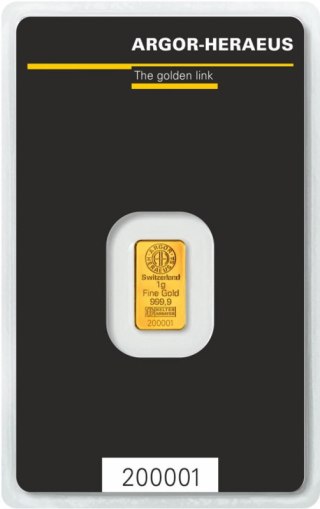
Argor-Heraeus premium scales inversely to bar mass, similar to PAMP: 1 g — premium 15-25%, 5 g — premium 8-12%, 10 g — premium 5-7%, 20 g — premium 4-6%, 1 oz (31.103 g) — premium 3-5%, 50 g — premium 2.5-4%, 100 g — premium 2-3.5%, 1 kg — premium 1.5-3%. For accumulation strategy 1 oz or 20 g are optimal. For smaller dispensations (e.g. 5 g as gift) — smaller bars.