1 Austrian Gold Ducat Uncirculated — Central Europe's longest gold coin tradition
The Ducat is the longest continuously produced gold coin in Central Europe — its history as a unit of exchange dates back to the 14th century, and contemporary production by the Austrian Mint is a direct continuation of 700 years of tradition. The "uncirculated" (Stempelglanz) specimen contains 3.442 g of fine gold at 986/1000 fineness (23.75 karat — the historic Venetian Ducat standard, unchanged since the 13th century), with a gross mass of 3.49 g and a diameter of 19.75 mm.
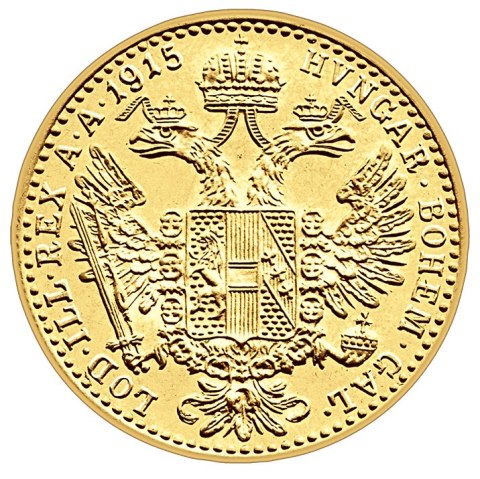
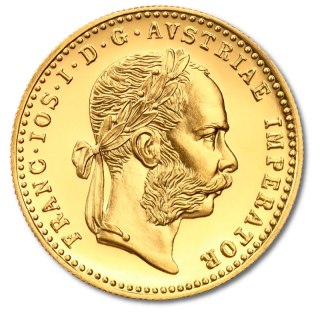
Each 1 Austrian Ducat bears the date 1915 on the reverse — regardless of the actual year of production. This is a deliberate decision by the Austrian Mint: 1915 was the last year of original circulation production, and from 1920 onwards all new Ducats are restrikes with this historic date. The "uncirculated" variant means the coin has never been in circulation — no scratches, wear, or patina. Market price: typically 4-6% over the LBMA gold price.
Why 1 Austrian Ducat?
- 3.442 g of 986/1000 fineness gold (Austrian Mint standard since 1872)
- Austrian Mint — history reaches back to 1194, modern restrike production since 1920
- Date 1915 on every specimen — direct reference to historical tradition
- Stempelglanz/Uncirculated — coin never in circulation, perfect condition
- Premium 4-6% over spot — rational due to restrike mass production
GoldInvest24 expert recommends — expert commentary
The Ducat as a monetary unit originates from the Republic of Venice, where it was introduced in 1284 by Doge Giovanni Dandolo. The standard of 3.5 g of gold at 986/1000 fineness — set in Venice — quickly spread throughout Europe: Hungary began minting Ducats in 1325 (King Charles Robert), Poland around 1320-1330 under Władysław Łokietek and Casimir the Great, Austria in the 15th century, German and Bohemian states in the 16th century. The Venetian standard endured over 600 years — Austria-Hungary officially continued Ducat minting at 986/1000 fineness until the fall of the monarchy in 1918.
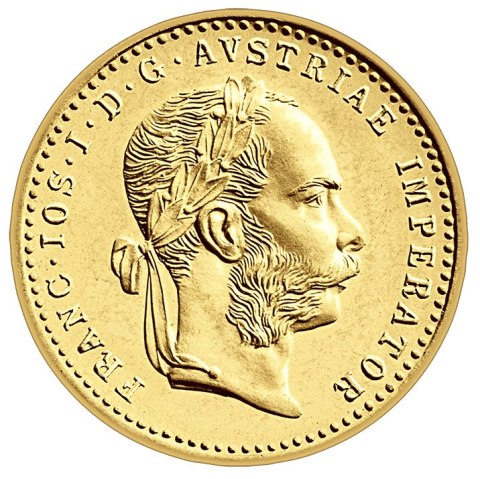
The obverse of the modern restrike depicts the portrait of Emperor Franz Joseph I in a laurel wreath, by Stefan Schwartz. The Emperor of Austria reigned for 68 years (1848-1916) — his portrait on the coin with the 1915 date symbolically captures the end of his rule. The reverse features the Habsburg double-headed eagle with imperial crown and the inscription "IMPERATOR AUSTRIAE HUNGARIAE BOHEMIAE GALLICIAE ILLYRIAE REX APOSTOLICUS ARCHIDUX AUSTRIAE" (Emperor of Austria, Hungary, Bohemia, Galicia, Illyria, Apostolic King, Archduke of Austria).
The Austrian Mint continues Ducat restrike production for two specific reasons: collector demand (mainly in Poland, Czech Republic, and Slovakia, where the Ducat has strong cultural roots) and demand for small gold formats (3.442 g is a practical exchange unit — larger than a 1 g bar, smaller than a 1/10 oz Vienna Philharmonic). The Central European market consumes a significant part of annual production — the Ducat is traditionally a classic First Communion, wedding, and anniversary gift.
Ducat — 700 years of Central European gold coin tradition
The first Central European Ducats were minted in the first half of the 14th century — the earliest confirmed specimens come from Poland under Władysław Łokietek (reign 1320-1333) and Hungary under Charles Robert. More regular production began under Casimir the Great (1333-1370), who reorganised the Polish mint in Kraków and introduced the Ducat as exchange currency for foreign trade. Over subsequent centuries the Ducat remained the standard gold coin of Central Europe — minted by the Jagiellonians, Habsburgs, and Bohemian kings.
With Austria's rise after the Holy Roman Empire reforms, Vienna became the main centre of Ducat minting in Central Europe. In the 19th century Austria-Hungary standardised the Ducat to a pure bullion form (1872 reform — Austrian Mint sets the definitive specification 3.442 g/986, identical to the Venetian original). 1915 was the last year of circulation minting — soon after, the monarchy collapsed in WWI.
The modern restrike tradition began in 1920, when the new Austrian Republic decided to continue the historic coin in a bullion form. Today the 1 Austrian Ducat is one of the most-purchased small gold coins in Central Europe — especially popular in Poland, Czech Republic, and Slovakia as a classic gift, and in Austria-Germany as a practical unit of gold accumulation. Continuous tradition (Venice 1284 → Central Europe 14th c. → Habsburg Empire → modern Republic) makes the Ducat the gold coin with the longest unbroken history in the European space.
What to look out for before buying?
- Authenticity — gross weight 3.49 g (±0.01), diameter exactly 19.75 mm, thickness 0.8 mm
- "Uncirculated" condition — coin without the slightest wear; visible patina indicates the "circulated" variant (cheaper)
- Premium — 4-6% is standard; above 8% signals high margin, below 4% is a good price
- Date 1915 — EVERY Austrian Ducat carries this date regardless of production year (restrike)
- Storage — safe class S2, original capsule or blister
Why buy at GoldInvest24?
- Ducat price updated according to LBMA gold price
- Available variants: "circulated" (lightly worn) and "uncirculated" (Stempelglanz)
- Option to buy the 4-Ducat coin in the Gold Coins category
- Shipments over EUR 7,000 are insured, courier delivery 1-3 business days
Technical specification
| Parameter |
Value |
| Product type |
Bullion coin (historic restrike) |
| Manufacturer |
Münze Österreich AG (Austrian Mint) |
| Location |
Vienna, Austria |
| Precious metal |
Gold Au |
| Fineness |
986/1000 (23.75 karat, Venetian standard 13th c.) |
| Fine gold weight |
3.442 g |
| Gross weight |
3.49 g |
| Diameter |
19.75 mm |
| Thickness |
0.8 mm |
| Form |
Minted coin (restrike) |
| Face value |
1 Ducat (historic, no legal tender status) |
| Date struck on coin |
1915 (every specimen) |
| Condition |
Uncirculated (Stempelglanz) |
| Obverse designer |
Stefan Schwartz (Franz Joseph I portrait) |
| First Central European Ducat |
approx. 1320 (Władysław Łokietek) |
| Packaging |
Protective capsule or blister |
| VAT |
Exempt under Council Directive 98/80/EC |
Comparison table — small gold coins (~3-4 g)
| Coin |
Fine gold |
Characteristic |
| 1 Austrian Ducat |
3.442 g (986) |
700 years tradition, restrike, low premium 4-6% |
| 1/10 oz Vienna Philharmonic |
3.1103 g (999.9) |
10 EUR face value, premium 7-10%, higher fineness |
| 10 Francs Marianne and Rooster |
2.903 g (900) |
Historic (1899-1914), no restrike, collector |
| 5 Pesos Mexico |
3.75 g (900) |
Historic Mexican, similar Ducat format |
FAQ — frequently asked questions
Why does every 1 Ducat carry the date 1915 regardless of purchase year?
After the fall of the Austro-Hungarian monarchy (1918), the Austrian Mint continues Ducat production as restrike with the date of the last original circulation year (1915). This is a deliberate decision — the coin maintains historical continuity, and the buyer knows they receive a modern product (no risk of circulation wear), but in the classical design of Emperor Franz Joseph I's era.
What's the difference between "circulated" and "uncirculated" Ducat?
"Circulated" (Umlaufqualität) is a Ducat with traces of circulation — small wear, light patina, contact marks from other coins. "Uncirculated" (Stempelglanz) is a coin directly from the mint, in perfect condition with mirror backgrounds. The uncirculated variant typically costs 2-4% more but retains value better on resale.
Is the 1 Ducat a good First Communion gift?
Yes — it is a classic First Communion gift in Central European tradition since the 19th century. A value of EUR 200-280 fits the typical gift budget from grandparents or godparents. An additional value is the emotional continuity — many Central European families have Ducats passed down through generations, so a new Ducat becomes a natural continuation of the family collection.
Is the Ducat VAT-exempt?
Yes. Fineness 986/1000 (23.75 karat) significantly exceeds the European minimum of 900/1000 for bullion coins. VAT exemption applies under Council Directive 98/80/EC.
1 Ducat vs 4 Ducats — what to choose?
4 Ducats contain 4× more gold (13.76 g vs 3.442 g) at a similar market premium, so the per-gram price is better for the 4-Ducat. Choosing 1 Ducat makes sense if you want a gift format, a smaller single amount, or plan gradual accumulation. 4 Ducats is a "medium" format — for buyers acquiring a larger piece of gold in one transaction.
Where does the 986/1000 standard come from?
The Republic of Venice introduced the Ducat in 1284 with a precisely defined fineness of 23.75 karat (986/1000), a mass of 3.5 g, and a diameter of about 20 mm. This standard was adopted by all European states minting Ducats (Hungary, Poland, Austria, Germany, Bohemia). Fineness 986 instead of 999.9 results from 13th-century refining technology — at that time 986 was the maximum achievable purity.
Where can I check the current gold price?
The current spot price is available at GoldInvest24 — sections Gold price and Precious metals prices.
Choose the 1 Austrian Gold Ducat Uncirculated at GoldInvest24 — continuation of 700 years of Central European tradition. Check the current gold price and compare with the Gold Coins category and Precious metals prices.