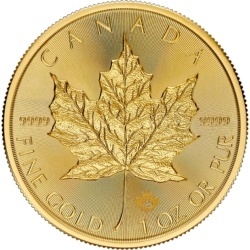
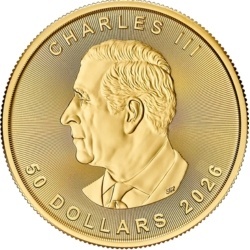
1 oz Maple Leaf 2026 — the only classic bullion gold coin combining three historic security innovations in numismatic history
The Maple Leaf is the flagship series of Royal Canadian Mint, whose debut in 1979 revolutionized the global investment gold market. The coin contains 31.103 g of 999.9/1000 fineness gold in a uniform 1 troy oz strike. Diameter 30 mm, thickness 2.87 mm, face value 50 CAD (Canadian dollars) — full legal tender status in Canada. The 2026 vintage is the third production year with Charles III portrait on the obverse (Steve Rosati, design approved 2024).
The price of 1 oz Maple Leaf 2026 is linked to the current precious metal price at LBMA, with typical market premium of 5-7% over spot — in the segment of best 1 oz .9999 coins worldwide, on par with Austrian Philharmonics. Maple Leaf is the only classic bullion coin combining three historic security innovations: first .9999 coin in the world (1982), first with Bullion DNA technology (2013) — micro-engraved tiny leaf with production year visible only under loupe — and radial security lines (since 2013) creating a "shimmer" light pattern at angles.
Why 1 oz Maple Leaf 2026?
- 31.103 g of 999.9/1000 fineness pure gold — first classic 1 oz .9999 in the world (since 1982)
- Royal Canadian Mint — Canada's national mint established 1908 (Ottawa, Winnipeg)
- Bullion DNA Security — micro-engraved maple leaf with year visible only under 10× loupe (since 2013)
- Charles III portrait — Steve Rosati (approved 2024), third production year with new monarch
- 50 CAD face value — full legal tender status, physical durability despite .9999
GoldInvest24 expert recommends — expert commentary
The Royal Canadian Mint was established on January 2, 1908 as a branch of the British Royal Mint in Ottawa — in response to the need to refine Canadian gold from the Klondike Gold Rush (1896-1899). The mint gained independence from the British Crown in 1931 (Statute of Westminster). Today, the Royal Canadian Mint owns two locations: Ottawa (numismatic and collector production) and Winnipeg (Maple Leaf bullion production). The mint is a Crown Corporation controlled by the Canadian government — the only structure in the world where a national mint operates as a commercial corporation under full state audit.
The Royal Canadian Mint's decision of 1979 to issue the Gold Maple Leaf was a strategic response to sanctions against South Africa and the suspension of Krugerrand imports in most Western countries. The first Maple Leaf issue had fineness 999 (Krugerrand had 916.7). In 1982 — as the first classic bullion coin in the world — it was raised to 999.9 (.9999). This was a revolution: the "gold without alloy" motif changed market perception and provoked other producers (Philharmonics raised from 999 to 999.9 in 1989, Krugerrand remained at 916.7). Walter Ott, author of the 1979 maple leaf design, created a motif that is the most recognizable Canadian symbol worldwide.
The year 2013 was the second security revolution of Maple Leaf. The Royal Canadian Mint introduced Bullion DNA technology — a micro-engraved tiny maple leaf with production year struck within the main central leaf (visible only under 10× loupe) and radial security lines on both sides of the coin. Radial lines create a characteristic "shimmer" light pattern from various viewing angles — an effect impossible to replicate with conventional counterfeiting techniques. Additionally, the Royal Canadian Mint introduced the mobile app Bullion DNA Reader, which allows dealers and collectors to scan the unique DataBar code next to the micro-leaf — and verify the coin's authenticity in the mint's database in real time.
Maple Leaf — the first classic .9999 bullion coin and its physical implications
The Royal Canadian Mint's 1982 decision to raise Maple Leaf fineness to 999.9/1000 was a historic breakthrough. At the time, the British tradition of Crown Gold 22 karat (916.7/1000), established by Henry VIII in 1526, dominated. Admixture 8.33% (typically silver + copper) provided coins with hardness necessary for physical circulation. The introduction of 999.9 meant abandoning this tradition — the coin becomes significantly softer, susceptible to scratches and fingerprints. The Royal Canadian Mint accepted this compromise in exchange for mathematical purity: 1 troy oz of pure gold = 1 troy oz of coin gross, without "diluting" value by alloy.
Practical consequence: Maple Leaf 1 oz coins require more careful storage than 22-karat ones (Krugerrand, American Eagle). The Royal Canadian Mint delivers every 1 oz coin in a factory plastic blister or protective capsule — the packaging is not optional, it's part of the product. Removing the coin from the blister lowers the resale price by 1-3% due to scratch and fingerprint risk. For accumulation strategy (goal: maximum gold mass, sale in 10-20 years) — Maple Leaf requires the original manufacturer's packaging throughout the storage period.
The combination of .9999 + Bullion DNA + Charles III portrait makes Maple Leaf 2026 the most technologically secured 1 oz bullion on the market. American Eagle 1 oz has no micro-engraving or verification app. Krugerrand 1 oz has no additional security features. Philharmonics 1 oz have gradually introduced security features (since 2024 micro-engraved "W" in the field next to the Vienna Music Society organs), but without a mobile app. Britannia 1 oz has had animated security features (animated security tridents) since 2021, but also without a verification app. Maple Leaf 1 oz is the only classic bullion coin with an integrated ecosystem for authenticity verification in a mobile app.
What to consider when buying 1 oz Maple Leaf 2026?
First: storage in factory packaging is critical. The .9999 coin is physically soft — removal from the blister leads to scratches and fingerprints that lower resale price. The Royal Canadian Mint delivers Maple Leaf in factory plastic blisters — keep them intact throughout the entire ownership period.
Second: vintage 2026 is the third with Charles III portrait. Vintage 2024 (first coin with new monarch) had collector premium 10-15% over metal content. Vintage 2025 — 4-6%. Vintage 2026 — without collector premium, optimal economy for pure bullion strategy. Vintages with Queen Elizabeth II portrait (1979-2023) retain value similar to 2026 — with small variations for individual vintages.
Third: the Bullion DNA Reader app is practical at resale. After purchasing Maple Leaf 1 oz, scan the DataBar with the Bullion DNA Reader app (downloadable on iOS/Android, free) — you'll get authenticity confirmation in the Royal Canadian Mint database. The verification receipt may be useful in bullion resale (increases buyer confidence, reduces need for additional verification).
Why GoldInvest24?
- Shipment of coins in factory Royal Canadian Mint blisters — crucial for maintaining market premium at resale
- Dynamic pricing linked to precious metal prices at LBMA, updated in real time
- Possibility to verify every Maple Leaf coin in the Bullion DNA Reader app — directly with the Royal Canadian Mint database
- Secure courier shipment with full insurance and discreet packaging maintaining transaction anonymity
- Experienced GoldInvest24 expert team — we help select products for your strategy (DCA, mass accumulation, jurisdictional diversification)
Technical specification 1 oz Maple Leaf 2026
| Parameter |
Value |
| Gold weight (Au) |
31.103 g (1.000 troy oz) |
| Fineness |
999.9/1000 (.9999, 24 karat) |
| Diameter |
30.0 mm |
| Thickness |
2.87 mm |
| Face value |
50 CAD (legal tender Canada) |
| Producer |
Royal Canadian Mint (Ottawa 1908, Maple Leaf production: Winnipeg) |
| Obverse |
Charles III — Steve Rosati (approved 2024) |
| Reverse |
Maple leaf — Walter Ott (1979) |
| Security features |
Micro-engraved leaf with year (Bullion DNA, since 2013) + radial lines |
| Verification |
Mobile app Bullion DNA Reader (iOS/Android) |
| Status |
LBMA Good Delivery, legal tender (Canada) |
| Market premium |
5-7% over spot |
| VAT |
Exempt (Council Directive 98/80/EC across EU) |
1 oz Maple Leaf 2026 vs competition 1 oz
| Feature |
Maple Leaf 1 oz |
Philharmonic 1 oz |
Britannia 1 oz |
American Eagle 1 oz |
Krugerrand 1 oz |
| Fineness |
999.9 (.9999) |
999.9 (.9999) |
999.9 (.9999) |
916.7 (22kt) |
916.7 (22kt) |
| Micro-engraving |
YES (Bullion DNA 2013+) |
YES (since 2024) |
YES (since 2021) |
NO |
NO |
| Mobile app |
YES (Bullion DNA Reader) |
NO |
NO |
NO |
NO |
| Radial lines |
YES |
NO |
YES (since 2018) |
NO |
NO |
| First .9999 |
1982 (first classic) |
1989 |
2013 |
none (22kt) |
none (22kt) |
| Market premium |
5-7% |
5-7% |
5-8% |
5-8% |
4-6% |
Frequently asked questions (FAQ)
What is Bullion DNA technology and how does it differ from standard micro-engraving?
Bullion DNA is a complete security system of the Royal Canadian Mint introduced in 2013 — combining: (a) micro-engraved tiny maple leaf with production year visible only under 10× loupe, (b) unique DataBar code assigned to each coin, (c) mobile app Bullion DNA Reader which scans the DataBar and verifies authenticity directly in the mint's database. Other mints (Münze Österreich since 2024, Royal Mint since 2021) have only micro-engraving without mobile app and DataBar code — Maple Leaf remains the only classic coin with integrated verification ecosystem.
Does 1 oz Maple Leaf 2026 have collector premium over other vintages?
NO — vintage 2026 is the third with Charles III portrait and has standard market premium 5-7% over spot without additional collector premium. Vintages with collector premium: 2024 (first coin with Charles III, 10-15% over metal content) and 2025 (4-6%). Vintages with Queen Elizabeth II portrait (1979-2023) — small variations per year, generally similar to 2026.
Is 1 oz Maple Leaf VAT-exempt in EU?
YES — 999.9/1000 fineness significantly exceeds the 995/1000 minimum required for VAT exemption on investment gold (Council Directive 98/80/EC across EU).
Why does Maple Leaf 1 oz require more careful storage than Krugerrand 1 oz?
Maple Leaf 1 oz has 999.9 fineness (pure 24-karat gold), Krugerrand 1 oz has 916.7 fineness (22 karat). The 8.33% admixture (silver + copper) in Krugerrand gives the coin higher physical hardness — resistance to scratches and fingerprints. Maple Leaf in factory plastic blister is safe; after removal from the blister, scratch and fingerprint risk is significantly higher. Recommended: keep the coin in original Royal Canadian Mint packaging throughout the entire storage period.
How to use the Bullion DNA Reader app?
Download the "Bullion DNA Reader" app on App Store (iOS) or Google Play (Android) — free. After purchasing Maple Leaf 1 oz, find the DataBar on the coin (small character string next to the micro-leaf — requires 10× loupe). Scan the code with the app — you'll receive authenticity confirmation in the Royal Canadian Mint database. Function particularly useful at resale (increases buyer confidence).
Maple Leaf 1 oz or Philharmonic 1 oz — which to choose?
Both are .9999 (31.103 g Au) with 5-7% premium. Differences: (a) Maple Leaf has Bullion DNA + verification app (since 2013), Philharmonics have micro-engraving since 2024 without app, (b) Maple Leaf diameter 30 mm vs Philharmonic 37 mm (larger, "thicker" coin), (c) motif — Maple Leaf maple leaf (Walter Ott, 1979), Philharmonics Vienna Music Society organs (Pesendorfer, 1989), (d) face value — 50 CAD (Maple Leaf) vs 100 EUR (Philharmonics). For maximum security: Maple Leaf. For larger size/European face value: Philharmonics.