1g Gold Bar LBMA circulated — 999.9 loose, without blister or certificate
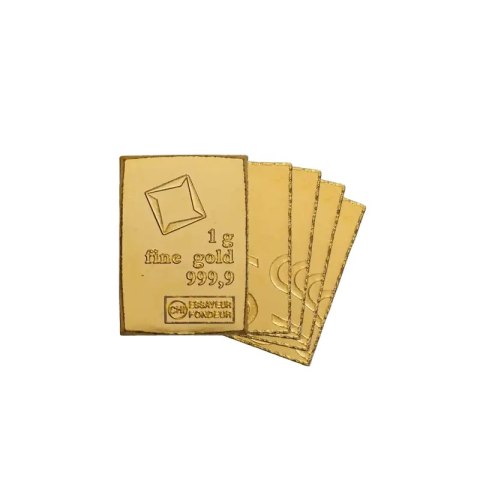
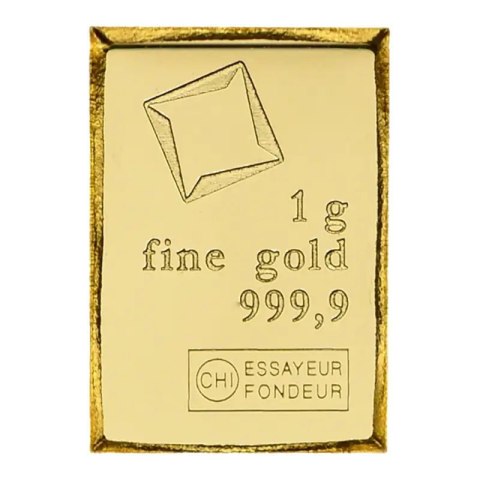
The circulated 1 g gold bar is a minted bar from a refiner on the LBMA Good Delivery list, 999.9/1000 fine, sold loose — without blister, certificate or any producer packaging. It comes from buy-back and resale, may show signs of handling (light scratches, dulled edges), but contains exactly 1 g of fine gold and is identified by the refiner's stamp with fineness and weight. The producer is not selectable — the bar comes from current stock and may be from any LBMA-listed refiner. The photograph is illustrative and shows Valcambi CombiBar segments. The sale is VAT-exempt under Article 344 of Directive 2006/112/EC.
Technical specification
| Parameter |
Value |
| Gold weight |
1.00 g (0.03215 troy oz) |
| Fineness |
999.9/1000 |
| Producer |
refiner on the LBMA Good Delivery list, no choice of brand; illustrative photo — Valcambi CombiBar segments |
| Dimensions |
depend on the refiner and bar format |
| Condition |
circulated / from resale — signs of handling possible |
| Packaging |
no blister, certificate or producer packaging; shipped in a protective pouch |
| Serial number |
depends on the producer — some 1 g bars have none |
| Constant features |
refiner's stamp, weight mark 1 g and fineness 999.9 on the obverse |
| VAT (EU) |
exempt — Directive 2006/112/EC, Art. 344 (gold bullion) |
Why this bar
- 1 g of 999.9 gold without the cost of a new blister and card: the premium over the metal value is lower than for a factory-sealed bar of the same weight.
- The refiner is always on the LBMA Good Delivery list — fineness and weight are struck into the bar, regardless of the missing packaging.
What a circulated bar is
New 1 g bars are sold in a blister with a printed certificate because the bar itself is too small for a serial number or hologram; the packaging accounts for a substantial part of the price above the gold value. A circulated (back-dated, pre-owned) bar is a piece without its blister — opened or lost by a previous owner — or a segment broken off a CombiBar plate. The gold loses nothing — 1 g of 999.9 remains 1 g of 999.9 — but the bar is cheaper because it no longer has "factory new" status. The dimensions of 1 g bars depend on the refiner and format, so this listing gives no single size.
Technology and security — what remains without the blister
On the obverse of a 1 g bar every refiner strikes its logo, the weight ("1 g"), the metal mark ("Au" or "Fine Gold") and the fineness ("999.9"); some add an assayer's mark (e.g. "Essayeur Fondeur" on Swiss refiners' bars). These elements are struck into the metal and do not disappear with the packaging. What is missing is a serial number matching a card and a Kinegram hologram or Veriscan check, which work only together with the blister. An unpackaged bar is therefore checked by weight (1.00 g on a 0.01 g scale), stamp legibility and fineness — the last confirmed non-destructively by XRF measurement.
Formats and weights — where 1 g makes sense
The 1 g bar is the lower limit of bullion formats; the next are 2 g, 2.5 g, 5 g, 10 g, 20 g, 1 oz (31.1035 g), 50 g and 100 g. The smaller the weight, the larger the share of striking and packaging in the price — at 1 g the difference between a new and a circulated bar is proportionally the greatest. New 1 g bars in blister are in the 1 g gold bars category: Argor-Heraeus, Argor-Heraeus Kinebar, Valcambi and PAMP Fortuna. Larger weights are grouped in the gold bars category.
What to look for when buying
You do not choose the producer or the design — you receive a bar from current stock, from an LBMA refiner, 999.9 fine and 1 g in weight. The photograph is illustrative: the actual piece may be from a different refiner and show signs of handling. On resale, a bar without blister is valued mainly by weight and fineness; some buyers apply a lower rate for missing packaging. As a gift, the blister version with certificate is the clearer choice.
Why GoldInvest24
Under this listing we sell only bars from refiners on the LBMA Good Delivery list, shipped in a protective pouch. Parcels are insured and packed neutrally. The price of 1 g of gold at the current rate is on the gold price page.
Comparison: circulated 1 g bar and new 1 g bars
| Bar |
Producer |
Fineness |
Packaging |
Verification |
| 1g Gold Bar LBMA circulated (this item) |
LBMA refiner, no choice |
999.9 |
no blister or card |
refiner's stamp (logo, weight, fineness) |
| Argor-Heraeus 1 g |
Argor-Heraeus |
999.9 |
blister with certificate |
certificate number, Essayeur Fondeur mark |
| Argor-Heraeus Kinebar 1 g |
Argor-Heraeus |
999.9 |
blister with certificate |
Kinegram hologram on the reverse |
| Valcambi 1 g |
Valcambi |
999.9 |
blister with certificate |
serial number on the card |
| PAMP Fortuna 1 g |
PAMP |
999.9 |
CertiPAMP blister |
Veriscan — image verification |
Frequently asked questions
Is a 1 g bar without blister worse than a new one?
The gold content is identical: 1 g of 999.9 from an LBMA refiner. The difference is in packaging and surface — no blister, no certificate, possible scratches. That is why it is cheaper than a new bar of the same weight.
Which refiner's bar will I receive?
That is not known in advance — we ship a bar from current stock, always from a refiner on the LBMA Good Delivery list. The photograph is illustrative and shows Valcambi CombiBar segments. If you want a specific brand, choose a new bar from the 1 g category.
How do I check a 1 g bar without a certificate?
A 0.01 g scale should show 1.00 g, and the stamp with fineness 999.9 and the refiner's logo must be legible. Fineness is confirmed non-destructively by XRF measurement.
Can I resell a bar without blister?
Yes. A bar without blister is valued mainly by the weight and fineness of the gold; some buyers apply a lower rate for missing packaging.