![[{[item.product.name]}]]([{[item.product.photo.url]}] 75w)
For free delivery are missing -,--
Order Summary
Sum 0,00 £
Price includes discounts
Chinese Panda Gold Coins
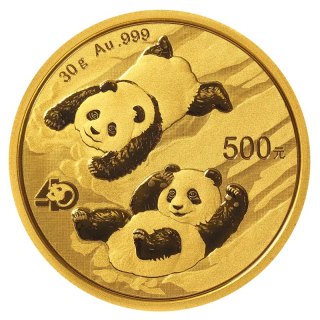
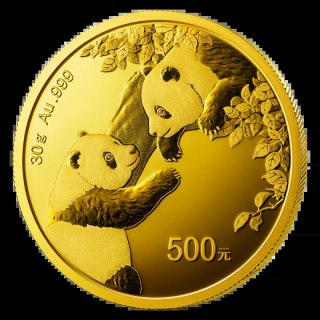
Number of products: 15The Panda is the one coin in this range that is not sold by the ounce. From 2016 the People's Bank of China switched the series to metric weights: the flagship coin is 30 g, not 31.10 g. It is close enough to be mistaken for an ounce and light enough that the difference matters when you price it.
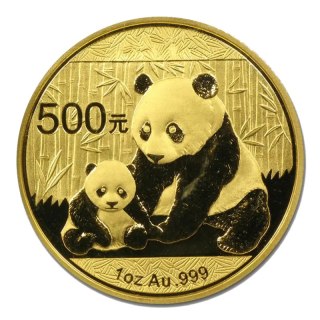
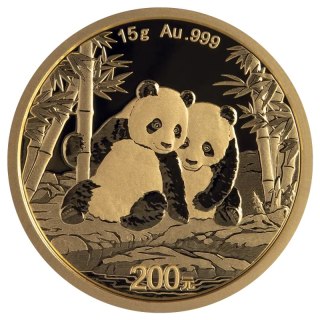
It is also 999 fine rather than 999.9, and its reverse is redrawn every year, as on the Australian Kangaroo — with one documented exception, 2002.
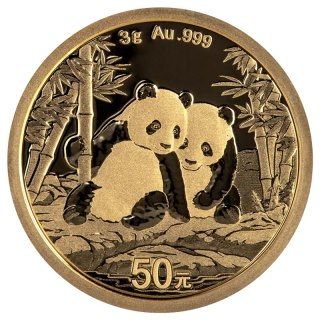
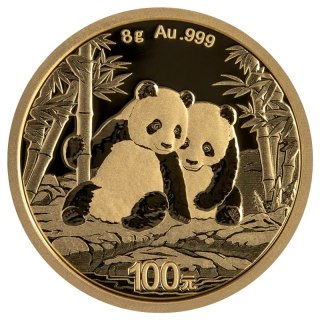

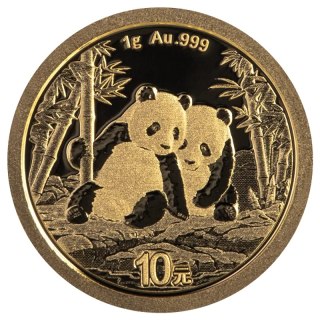
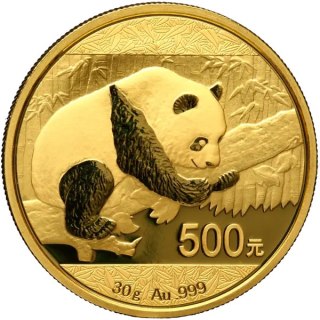
Two systems: before and after 2016
Coins dated 1982 to 2015 follow troy ounces. Coins from 2016 follow grams. Both are 999 fine, and the diameters were largely carried across, which is why the two systems are easy to confuse.
| System | Coin | Fine gold | Fineness | Diameter | Face value |
|---|---|---|---|---|---|
| Metric, 2016 onwards | 30 g | 29.97 g | 999 | 32.00 mm | 500 CNY |
| Metric | 15 g | 14.99 g | 999 | 27.00 mm | 200 CNY |
| Metric | 8 g | 7.99 g | 999 | 22.00 mm | 100 CNY |
| Metric | 3 g | 2.997 g | 999 | 18.00 mm | 50 CNY |
| Metric | 1 g | 0.999 g | 999 | 10.00 mm | 10 CNY |
| Troy, 1982–2015 | 1 oz | 31.07 g | 999 | 32.05 mm | 100 then 500 CNY |
| Troy | 1/2 oz | 15.54 g | 999 | 27.00 mm | 50 then 200 CNY |
| Troy | 1/4 oz | 7.77 g | 999 | 21.95 mm | 25 then 100 CNY |
| Troy | 1/10 oz | 3.11 g | 999 | 17.95 mm | 10 then 50 CNY |
| Troy | 1/20 oz | 1.55 g | 999 | 13.92 mm | 5 then 20 CNY |
Face values also moved: the one-ounce coin was 100 yuan from 1982 to 2000 and 500 yuan from 2001, which is the denomination the 30 g coin carries today.
A new design every year, with one exception
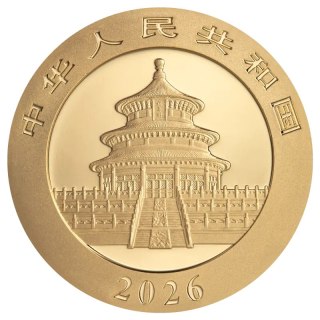
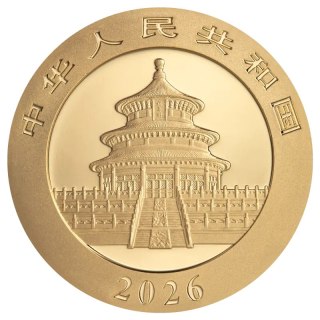
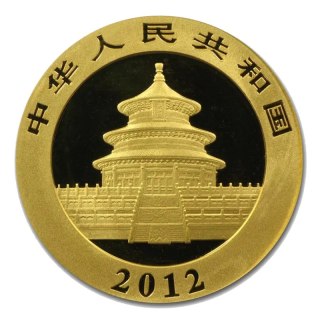
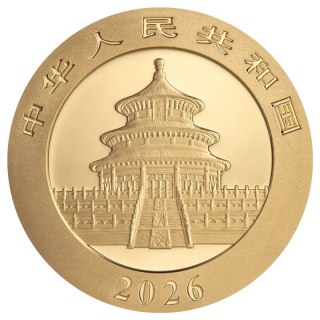
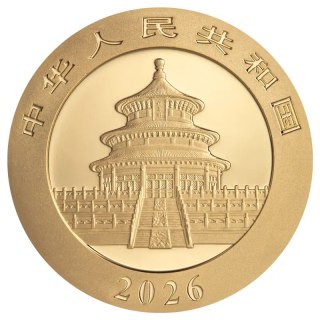
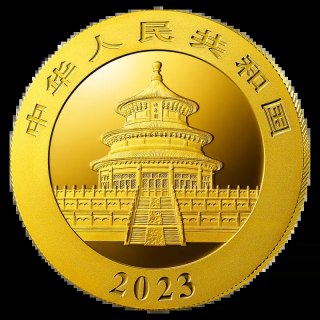
The obverse is fixed — the Temple of Heaven in Beijing, the state name and the year. The reverse shows a different panda each year. The single documented exception is 2002, whose reverse repeats the 2001 design.
That annual change is why Pandas carry a collector premium that the Maple Leaf and the Krugerrand do not, and why the year on the coin affects its price in a way it does not elsewhere in this category.
Who strikes them
Pandas are struck at several Chinese mints — Beijing, Shanghai, Shenyang and Shenzhen — under China Gold Coin Corporation, which is wholly owned by the People's Bank of China. Most years carry no mint mark, so attribution depends on die characteristics rather than a stamp.
None of those mints appears on the LBMA Good Delivery list, which accredits bar refineries rather than coin mints — see the American Eagle page for the detail.
What is in this category
Pandas from both weight systems, across a range of years. Because the reverse changes annually, individual years trade at different premiums over gold. Metal value tracks the gold price page.
Tax status
Gold bullion is exempt from VAT throughout the European Union under Council Directive 2006/112/EC, Articles 344–346. The exemption covers bars of a fineness of at least 995 thousandths and gold coins of at least 900 thousandths minted after 1800 that are, or have been, legal tender in their country of origin. GoldInvest24 is operated by a Polish company and applies that exemption, so the price shown is the price you pay. This describes how we invoice and is not tax advice — rules in your own country may differ.
Questions buyers ask
Is a Chinese Panda one ounce?
Only if it is dated 2015 or earlier. From 2016 the series uses metric weights and the flagship coin holds 30 g, which is 1.10 g less than a troy ounce.
What fineness is a Gold Panda?
999, not 999.9. That is true of both the troy-ounce coins and the metric ones.
Does the design change every year?
Yes, on the reverse; the obverse Temple of Heaven is fixed. The one documented exception is 2002, whose reverse repeats the 2001 panda.
Why do Pandas cost more than other bullion coins?
Because the annual design change creates collector demand on top of gold content. Coins whose design is fixed, such as the Krugerrand, trade much closer to metal value.
Which mint strikes them?
Several — Beijing, Shanghai, Shenyang and Shenzhen — under China Gold Coin Corporation, wholly owned by the People's Bank of China. Most years carry no mint mark.
Do you buy Pandas back?
Yes, quoted against the current gold price. Note that a 30 g coin holds less gold than a one-ounce coin, so the two are quoted differently. See the buyback page.
Other gold coin series
Sovereign · Krugerrand · Britannia · Maple Leaf · American Eagle · Vienna Philharmonic · Australian Kangaroo · 1 oz gold coins · historic coins
All series are listed together on the gold coins page. For the same metal without a face value, see gold bars.
Popular in this category
8 g Chinese Panda Gold Coin | 2026 · 15 g Chinese Panda Gold Coin | 2026 · 1 g Chinese Panda Gold Coin | 2026