![[{[item.product.name]}]]([{[item.product.photo.url]}] 75w)
For free delivery are missing -,--
Order Summary
Sum 0,00 £
Price includes discounts

250 g Gold Bars
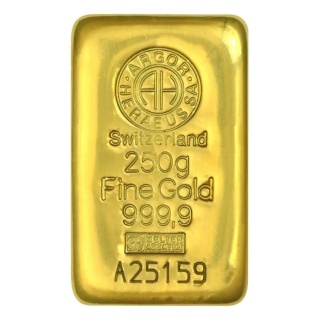
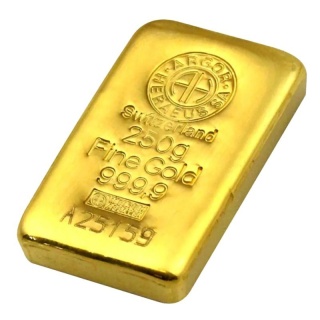
Number of products: 3Above 100 g the pressing lines largely stop and the pouring lines take over. Most 250 g bars are cast, and it shows: Argor-Heraeus gives 50.0 × 31.0 × 9.0 mm — barely longer than its 100 g minted bar, but more than twice as thick, with the rounded edges and slightly uneven top face that cooling metal leaves behind.
This is the lightest of the three large formats we stock, and the point at which packaging changes from sealed card to loose bar with documentation.
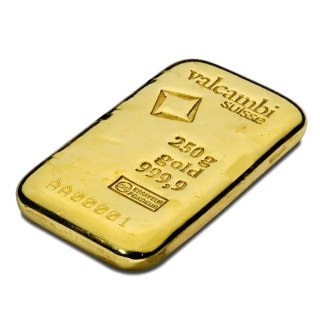
How big a 250 g gold bar actually is
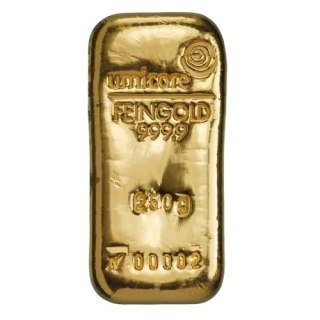
Cast bars are described by their top face, because the sides taper — the mould is wider at the top than at the bottom so the bar releases cleanly. Umicore publishes both faces, which makes the taper visible in the numbers; Argor-Heraeus publishes one set of figures.
| Refiner or standard | Dimensions | Form | Packaging |
|---|---|---|---|
| Argor-Heraeus | 50.0 × 31.0 × 9.0 mm | cast | supplied loose with assay documentation |
| Umicore | top face 57 × 28 mm, base 52 × 23 mm, approx. 10.0 mm thick | cast | supplied loose |
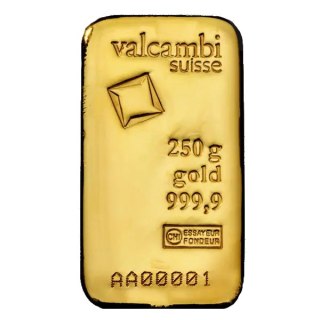
Valcambi publishes no dimensions for its 250 g bar, and its own catalogue and our listing describe the format differently, so we do not state minted or cast for the Valcambi bar without checking the individual product page.
What casting changes
A poured bar is not refined differently and is not less pure — the gold here is 999.9, the same as on a 1 g card. What changes is the surface: cast bars carry flow marks, slightly rounded corners and a matte finish, and no two are quite identical. Serial numbers on cast bars are commonly struck or etched directly into the metal rather than printed on packaging.
Casting is also cheaper, which is the reason the premium per gram at 250 g and above is the lowest in the range.
Refiners in this weight
Argor-Heraeus, Valcambi, C.Hafner and Umicore. All four appear on the LBMA Good Delivery list for gold — an accreditation of the refinery and its assay process, not of the individual bar. The LBMA does not issue a certificate for an individual retail bar, and no bar of this size is a London Good Delivery bar — that standard starts at around 350 troy ounces.
What you actually pay
The metal value of 250 g at the market price, plus a premium that is now a small percentage of the total, plus our margin. In ounce terms, 250 g is 8.04 troy ounces. The trade-off against the 100 g format is liquidity: a smaller bar is easier to sell in part. Live prices on the gold price page.
Tax status
Gold bullion is exempt from VAT throughout the European Union under Council Directive 2006/112/EC, Articles 344–346. The exemption covers bars of a fineness of at least 995 thousandths and gold coins of at least 900 thousandths minted after 1800 that are, or have been, legal tender in their country of origin. GoldInvest24 is operated by a Polish company and applies that exemption, so the price shown is the price you pay. This describes how we invoice and is not tax advice — rules in your own country may differ.
Questions buyers ask about this weight
How much is a 250 g gold bar worth?
250 times the gold price per gram, plus the premium. That is 8.04 troy ounces of gold, so an ounce quote needs converting before you compare.
How big is a 250 g gold bar?
50.0 × 31.0 × 9.0 mm at Argor-Heraeus. The Umicore cast bar has a 57 × 28 mm top face, a 52 × 23 mm base and is around 10.0 mm thick — the difference between the two faces is the mould taper.
Why is it so much thicker than a 100 g bar?
Because it is cast rather than pressed. A poured bar grows in depth rather than in area, so 250 g of gold ends up barely longer than 100 g of gold but two to three times as thick.
Does a cast bar come with paperwork?
Yes — assay documentation stating weight and fineness, and a serial number, which on cast bars is usually struck or etched into the metal itself rather than printed on a card.
Can I sell a 250 g bar back?
Yes, quoted against the current market price. Larger bars have to be sold whole, which is the main practical difference from holding the same weight in smaller units. See the buyback page.
Other gold bar weights
0.5 g · 1 g · 2 g · 2.5 g · 5 g · 10 g · 20 g · 1 oz · 50 g · 100 g · 500 g · 1 kg
All weights are listed together on the gold bars page. For coin formats in the same metal, see gold coins.
Popular in this category
250 g Gold Bar | Argor-Heraeus | Cast · 250 g Gold Bar | Valcambi | Cast