![[{[item.product.name]}]]([{[item.product.photo.url]}] 75w)
1 oz Krugerrand Gold Coin | 2026
The Symbol: 116276
1 oz Krugerrand 2026 — oldest modern bullion coin since 1967 (Crown Gold), Rand Refinery RSA, LBMA Good Delivery. GoldInvest24.
Availability: In stock 500000 PCs.
Price: 17058.88
For free delivery are missing -,--
Sum 0,00 £
Price includes discounts
The Symbol: 116276
1 oz Krugerrand 2026 — oldest modern bullion coin since 1967 (Crown Gold), Rand Refinery RSA, LBMA Good Delivery. GoldInvest24.
Availability: In stock 500000 PCs.
Price: 17058.88
First minted in 1967, the Krugerrand is the coin that defined the concept of “bullion gold” in its modern form. The 2026 vintage is the 60th issue of the series — the coin contains 31.103 g of fine gold at 916.7/1000 fineness (Crown Gold, copper alloy for durability) and carries no face value. It is the only one among the world's major bullion coins whose value is determined solely by gold content — without a fictional legal tender value.
The market price of the 1 oz Krugerrand typically sits 1-3% over the LBMA gold price — the lowest markup among classic bullion coins. This is the result of vast production scale (over 50 million ounces minted since 1967), universal recognition on the secondary market, and the absence of “nominal cost” — the South African Mint doesn't need to guarantee legal tender status.
The South African Mint, based in Pretoria, was founded in 1890 as the mint of the South African Republic. The Krugerrand was put into production in 1967 with a very specific economic goal: following the discovery of the world's largest gold deposits in the Witwatersrand (1886), South Africa needed a mechanism to sell gold abroad to retail buyers, without intermediation by central banks and the Bretton Woods system. The solution was the first modern bullion coin — sold directly to buyers at a price close to spot value, without collector markup over spot and without artificial face value.
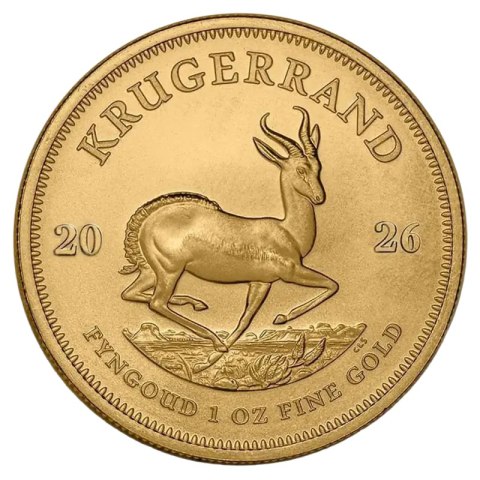
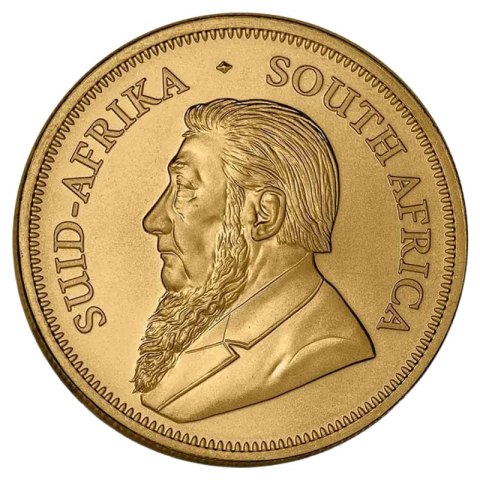
The obverse depicts the portrait of Paul Kruger — President of the South African Republic from 1883 to 1900, symbol of the Boer struggle for independence — by Otto Schultz. The reverse presents a springbok (springing antelope), the national animal of South Africa, designed by Coert Steynberg in 1947 (originally for a 5-shilling coin, later adapted for the Krugerrand). The name of the coin combines: “Kruger” (the president) + “Rand” (South African currency).
The Krugerrand dominated the bullion market in 1967-1980 — at its peak (1980) sales reached 6 million ounces annually. After UN sanctions against South Africa were imposed in 1981 (linked to apartheid), Krugerrand imports were banned in the US and most Western countries, creating a gap filled by the Maple Leaf (Canada, 1979), American Eagle (USA, 1986) and Vienna Philharmonic (Austria, 1989). After sanctions were lifted in 1994 the Krugerrand returned to circulation and, despite competition, remains one of the three most-purchased bullion coins in the world.
The 916.7/1000 fineness (22 karat, Crown Gold) is a deliberate choice by the South African Mint, not a flaw. The standard derives from British coinage law of 1816 — the same fineness used by the Sovereign (since 1817), American Eagle (since 1986) and 2 Rand South Africa (1961-1983). The copper alloy (8.3%) gives the coin its distinctive reddish hue and — more importantly — substantially increases its physical durability. You can carry a 916.7 Krugerrand in your pocket with keys without scratching the surface — something you cannot say of a 999.9 Maple Leaf, which loses its “polished” appearance at the slightest contact.
In practical bullion ownership the fineness difference doesn't matter — a 1 oz Krugerrand contains exactly the same amount of fine gold as a 1 oz Maple Leaf (31.103 g). The difference is in coin gross mass: Krugerrand weighs 33.93 g (with copper), Maple Leaf 31.103 g (without alloy). From a market price standpoint what matters is fine gold content, not gross mass — so both coins have the same metal value. Choosing between them is a matter of aesthetic preference (reddish vs pure yellow), physical durability (Krugerrand higher) and market margin (Krugerrand usually lower).
Moreover, 22-karat Krugerrands have a historic collector advantage over their 24-karat competitors. Thanks to 59 years of continuous production (1967-2026), every year is available on the secondary market, including the sanctions-era vintages (1981-1993) that today are especially prized by collectors. Maple Leaf, American Eagle and Vienna Philharmonic have 12-22 years shorter history — with fewer vintages to collect.
| Parameter | Value |
|---|---|
| Product type | Bullion coin |
| Manufacturer | South African Mint |
| Location | Pretoria, South Africa |
| Precious metal | Gold Au (916.7) + Copper Cu (83.3) |
| Fineness | 916.7/1000 (Crown Gold, 22 karat) |
| Fine gold weight | 31.103 g (1 troy oz) |
| Gross weight | 33.93 g (with copper alloy) |
| Diameter | 32.69 mm |
| Thickness | 2.84 mm |
| Form | Minted coin |
| Face value | None (bullion without legal tender) |
| Year | 2026 (60th issue) |
| First minted | 1967 |
| Obverse designer | Otto Schultz (Paul Kruger portrait) |
| Reverse designer | Coert Steynberg (springbok) |
| Accreditation | Rand Refinery (LBMA Good Delivery) |
| VAT | Exempt under Council Directive 2006/112/EC |
| Coin | Fineness | Typical margin over spot |
|---|---|---|
| Krugerrand 1 oz | 916.7 | 1-3% (lowest) |
| Vienna Philharmonic 1 oz | 999.9 | 3-5% |
| Maple Leaf 1 oz | 999.9 | 3-5% |
| American Eagle 1 oz | 916.7 | 5-8% (US markup) |
Why does the Krugerrand have a lower fineness (916.7) than the Maple Leaf (999.9)?
It is a deliberate choice by the South African Mint in line with the British Crown Gold standard (916.7 fineness has applied since 1816). The copper alloy (8.3%) provides higher physical durability — the coin is resistant to scratches and deformation. Fine gold content (31.103 g = 1 oz) is IDENTICAL to the Maple Leaf — the only difference is in coin gross mass.
Why does the Krugerrand have no face value?
Because the South African Mint produces the coin as a bullion product, not as legal tender. This is a unique feature of the Krugerrand in the market — all other classic bullion coins (Vienna Philharmonic, Maple Leaf, Eagle, Britannia) carry a face value, though no one pays with them. The lack of face value means the Krugerrand's worth is determined solely by gold content — without “paper” legal tender value.
Are Krugerrands from 1981-1993 worth more?
Yes, they are particularly valued by collectors due to UN sanctions. During this period Krugerrand production fell from 6 million oz (1980) to less than 25,000 oz per year (1989-1993). Sanctions-era vintages can carry a margin over spot of 10-25% over metal value, depending on condition and rarity of the specific year.
Is the Krugerrand VAT-exempt?
Yes. Despite the lower fineness (916.7), the Krugerrand meets the European minimum of 900/1000 for bullion coins — VAT exemption applies under Council Directive 2006/112/EC.
Krugerrand vs Vienna Philharmonic 1 oz — which to choose?
Krugerrand: lower markup (1-3% vs 3-5%), higher physical durability, longer history (since 1967). Vienna Philharmonic: higher fineness (999.9 vs 916.7 — though gold content identical), euro face value (100 EUR), cultural motif. The choice is one of preference — both coins have the same metal value.
Where can I check the current gold price?
The current spot price is available at GoldInvest24 — sections Gold price and Precious metals prices.
Choose the 1 oz Krugerrand 2026 at GoldInvest24, check the current gold price and compare with the Gold Coins category and Precious metals prices.