![[{[item.product.name]}]]([{[item.product.photo.url]}] 75w)
For free delivery are missing -,--
Order Summary
Sum 0,00 £
Price includes discounts

1 kg Gold Bars
Number of products: 5The kilo bar is the heaviest format most retail buyers ever handle, and the one with the clearest written specification behind it. The LBMA, jointly with the Shanghai Gold Exchange, defines the 9999 kilobar as a minimum of 1000 g at 999.9 fineness, measuring 80–120 mm long, 40–60 mm wide and 7–14 mm high, accompanied by a Certificate of Analysis carrying the serial number, weight, fineness and an approved signature.
Argor-Heraeus pours 117.5 × 52.0 × 9.0 mm and the Perth Mint no more than 112 × 52 × 9 mm — both inside that envelope.
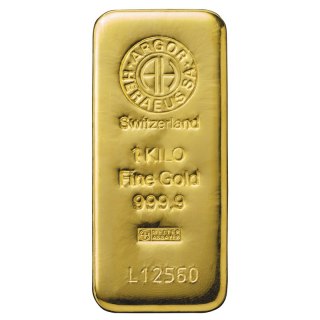
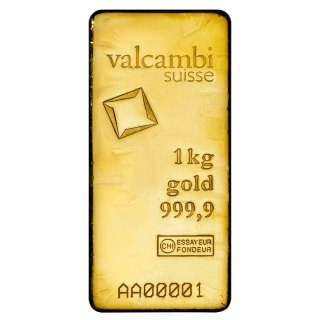
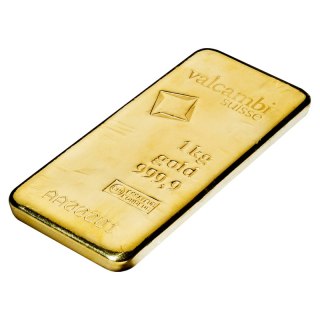
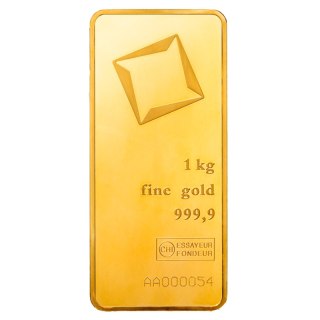
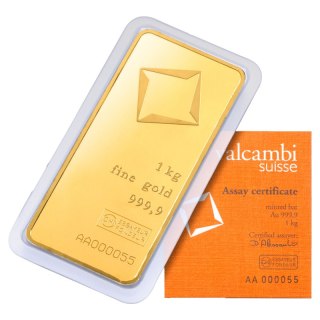
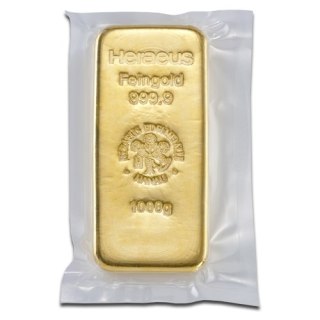
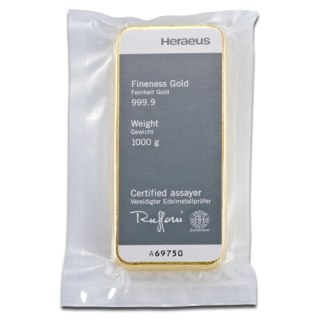
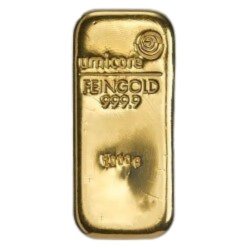
How big a 1 kg gold bar actually is
Shorter than a smartphone and about two thirds as wide, and heavy enough that most people underestimate it on first lift. A kilo of gold occupies about 52 cubic centimetres.
| Refiner or standard | Dimensions | Form | Packaging |
|---|---|---|---|
| Argor-Heraeus | 117.5 × 52.0 × 9.0 mm | cast | supplied loose with assay documentation |
| Perth Mint | 112 × 52 × 9 mm max., minimum weight 1000.010 g | cast | loose, serial number and production date struck on the bar |
| Umicore | top face 107 × 44 mm, base 103 × 40 mm, approx. 13.0 mm thick | cast | supplied loose |
| LBMA 9999 kilobar specification | 80–120 × 40–60 × 7–14 mm, min. 1000 g | cast | Certificate of Analysis required |
A kilo bar is not a London Good Delivery bar. The London standard covers bars of 350 to 430 troy ounces — roughly 10.9 to 13.4 kg — measuring around 250 × 70 × 35 mm at a minimum fineness of 995.0. The kilobar is a separate specification written for the Asian exchanges.
What the specification actually guarantees
The interesting part of the LBMA kilobar standard is not the dimensions but the paperwork. A conforming bar arrives with a Certificate of Analysis that ties a serial number to a stated weight and fineness under an approved signature. That is a documented chain from refinery to bar, which is what makes the format acceptable on exchanges without re-assay.
Note that the Perth Mint specifies a minimum weight of 1000.010 g rather than exactly 1000 g.
Refiners in this weight
Argor-Heraeus, Valcambi and Umicore, plus bars listed under mixed producers. Argor-Heraeus, Valcambi and Umicore all appear on the LBMA Good Delivery list for gold. As everywhere in this range, that accreditation is held by the refinery and covers its production and assay; the LBMA issues no certificate to a buyer.
What you actually pay
One kilogram of gold at the market price, plus the smallest premium percentage in the range, plus our margin. That is 32.15 troy ounces in a single object, which is the whole point and the whole limitation: the lowest cost per gram, and no way to release part of the holding without selling all of it. The 100 g format exists for exactly that reason. Live prices on the gold price page.
Questions buyers ask about this weight
How much is a 1 kg gold bar worth?
A thousand times the gold price per gram, plus the premium — which at this size is the lowest percentage in the range. One kilo is 32.15 troy ounces.
How big is a 1 kg gold bar?
117.5 × 52.0 × 9.0 mm at Argor-Heraeus and no more than 112 × 52 × 9 mm at the Perth Mint. The LBMA 9999 kilobar specification allows 80–120 mm by 40–60 mm by 7–14 mm.
Is a kilo bar a Good Delivery bar?
No. London Good Delivery bars weigh 350 to 430 troy ounces — around 10.9 to 13.4 kg — and are held at a minimum fineness of 995.0. The kilobar has its own specification, written by the LBMA with the Shanghai Gold Exchange, requiring 999.9 fineness and a Certificate of Analysis.
What documentation comes with it?
A Certificate of Analysis stating the serial number, weight and fineness under an approved signature. The serial number is struck into the bar itself; the Perth Mint also strikes the production date.
Can I sell a kilo bar back?
Yes, quoted against the market price on the day. It is a single indivisible unit, so the whole kilo moves in one transaction. See the buyback page.
Other gold bar weights
0.5 g · 1 g · 2 g · 2.5 g · 5 g · 10 g · 20 g · 1 oz · 50 g · 100 g · 250 g · 500 g
All weights are listed together on the gold bars page. For coin formats in the same metal, see gold coins.