![[{[item.product.name]}]]([{[item.product.photo.url]}] 75w)
For free delivery are missing -,--
Order Summary
Sum 0,00 £
Price includes discounts
Vienna Philharmonic silver coins
Number of products: 3The Vienna Philharmonic is denominated in euro — 1.50 € on the one-ounce silver coin. Münze Österreich calls it Europe's only bullion coin, and the euro face value is the reason.
It is 999 fine, 37.00 mm across, and the silver version has only existed since 1 February 2008; the gold Philharmonic goes back to 1989. Silver comes in one size only. Check the live silver price before you order.

A euro face value, and what that does not mean
Every other major bullion coin is denominated in a national currency outside the eurozone: rand, pounds, Canadian dollars, US dollars, yuan. The Philharmonic carries 1.50 €, which makes it legal tender across the euro area. That is a genuine distinction and it is why Münze Österreich describes it as Europe's only bullion coin.
What it does not do is give the coin a tax advantage. The face value is symbolic — far below the metal value — and no euro-area rule attaches to it the way the UK Capital Gains Tax exemption attaches to sterling coins.
Specification
| Parameter | Value |
|---|---|
| Fine silver | 31.10 g — one troy ounce |
| Fineness | 999 |
| Diameter | 37.00 mm |
| Face value | 1.50 EUR |
| Designer | Thomas Pesendorfer, chief engraver |
| First silver issue | 1 February 2008 |
| Sizes in silver | 1 oz only |
| Mint tube | 20 coins |
| VAT | Standard rate — silver is not exempt |
Münze Österreich publishes weight, fineness and diameter but not thickness, so we do not quote one.
Which side is which
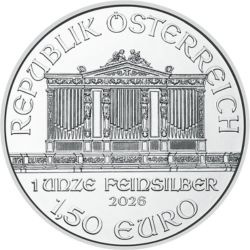
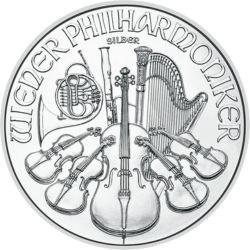
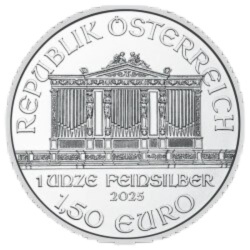
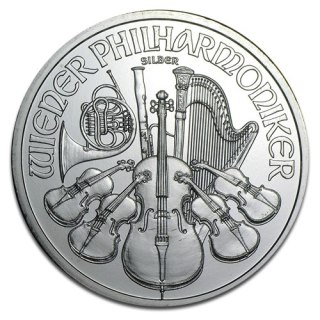
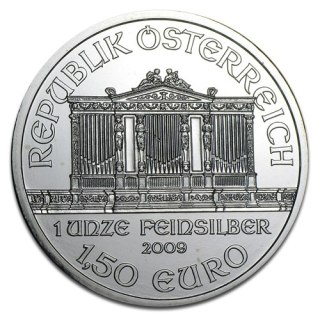
The obverse shows the great organ of the Golden Hall in Vienna's Musikverein, with the issuing country and the denomination: REPUBLIK ÖSTERREICH, 1 UNZE FEINSILBER, the year, and 1,50 EURO. The reverse shows the orchestra's instruments — a cello in front, violins, violas, a harp, a bassoon and a Vienna horn — under the legend WIENER PHILHARMONIKER SILBER.
Dealers sometimes reverse this and call the instrument side the obverse, because it is the better-known image. The organ side is the obverse by the usual convention: it carries the issuing state and the face value. Thomas Pesendorfer designed both, and the silver coin uses the 1989 gold design unchanged.
No security features — and that is worth stating plainly
The silver Philharmonic has no anti-counterfeit technology. No micro-engraving, no latent image, no laser mark, no database verification. Nor does the gold Philharmonic, despite a widely repeated claim about a micro-engraved "W" — we could not find that in any source from the mint, and it appears to be a confusion with the Maple Leaf's micro-engraved leaf.
If verifiable security features matter to you, the Silver Maple Leaf has micro-engraving, radial lines and Bullion DNA, and the silver Britannia has four visual features you can check by eye. The Philharmonic relies on dimensional accuracy and its distinctive rendering instead.
Packaging is different here
Most silver bullion ships in tubes of 25. Münze Österreich packs the Philharmonic in tubes of 20, and a master box holds 500 coins — 25 tubes of 20, not 20 tubes of 25. Shops occasionally state it the other way round; the total is the same, the tube count is not. It matters if you are ordering by the tube.
What you actually pay
Silver carries a much higher percentage premium over spot than gold, because fabrication and packaging cost roughly the same per coin whatever the metal is worth. Münze Österreich does not publish a mintage limit for the bullion Philharmonic — it is struck to demand, so there is no scarcity premium to wait for.
Tax position
VAT: silver is not investment gold. The exemption in Article 344 of Directive 2006/112/EC covers gold only. Münze Österreich itself prices the coin including 20% Austrian VAT. In Poland the rate is 23% on the full price — the margin scheme that used to soften this for silver effectively ended on 1 January 2025.
Capital Gains Tax in the UK: not exempt. The exemption covers sterling currency under HMRC's Capital Gains Manual at CG76881, and this coin is denominated in euro. The Royal Mint states the same from the other side: CGT applies to coins it did not produce, as they are not UK legal tender. General information, not tax advice.
Questions buyers ask
Why is the face value in euro?
Austria is in the eurozone, so the coin is denominated at 1.50 €. Münze Österreich calls it Europe's only bullion coin for that reason. The face value is symbolic and well below the silver value.
Does the silver Philharmonic have security features?
No. There is no micro-engraving or verification technology on either the silver or the gold version. The frequently repeated micro-engraved "W" is not documented by the mint.
Are there fractional silver Philharmonics?
No. Silver is one ounce only. The fractions — 1/2, 1/4, 1/10 and 1/25 oz — exist in gold.
How many coins in a tube?
Twenty, not twenty-five. A master box holds 500 coins in 25 tubes.
Will you buy a silver Philharmonic back?
Yes, against the current market price. See the buyback page for how the valuation works.
Other silver coin series
Krugerrand · Britannia · Maple Leaf · Australian Kangaroo · Chinese Panda · American Eagle · Somali Elephant
All series are listed on the silver coins page. For bar formats see silver bars, and for the gold version see Vienna Philharmonic gold coins.