1 oz Vienna Philharmonic 2025 — Austrian bullion gold coin from Münze Österreich with micro-engraved "W" security feature
Vienna Philharmonic 1 oz with 2025 vintage is the flagship bullion coin of Münze Österreich with 999.9/1000 fineness and 31.103 g net gold. Diameter 37 mm — largest among 1 oz classics, thickness 2.0 mm, face value 100 EUR — full legal tender status in the Eurozone.
The 2025 vintage is the second production year with the micro-engraved "W" security feature introduced in 2024. Motif of the Great Hall organ of the Vienna Musikverein on the obverse and eight instruments on the reverse by Thomas Pesendorfer (1989). The coin price is linked to current LBMA precious metals prices.
Technical specifications 1 oz Vienna Philharmonic 2025
| Parameter |
Value |
| Gold weight (Au) |
31.103 g (1.000 troy oz) |
| Fineness |
999.9/1000 (.9999, 24 karat) |
| Diameter |
37.0 mm (largest among 1 oz classics) |
| Thickness |
2.0 mm |
| Face value |
100 EUR (legal tender Eurozone) |
| Manufacturer |
Münze Österreich (Vienna, roots 1397) |
| Obverse |
Great Hall organ of the Vienna Musikverein (Pesendorfer, 1989) |
| Reverse |
Eight instruments of Wiener Philharmoniker (Pesendorfer, 1989) |
| Security features |
Micro-engraved "W" next to the organ (since 2024, second year 2025) |
| Accreditation |
LBMA Good Delivery since 2008 |
| Packaging |
Individual capsule |
| VAT |
Exempt (EU Directive 98/80/EC) |
Why 1 oz Vienna Philharmonic 2025?
- 31.103 g of 999.9/1000 fineness gold (.9999, 24 karat) — Austrian bullion standard from 1989
- Münze Österreich — one of Europe's oldest mints (Vienna, roots 1397), LBMA accreditation since 2008
- Diameter 37 mm — largest among 1 oz bullion classics (Maple Leaf 30 mm, Krugerrand 32.77 mm)
- Micro-engraved "W" — second vintage 2025 with laser security feature introduced in 2024
- Face value 100 EUR — full legal tender status in the Eurozone among 1 oz bullion classics
History of the Wiener Philharmoniker series — from 1989 debut to 2025 vintage
Münze Österreich is one of the oldest continuously operating national mints in Europe. The first mention of a state Austrian mint in Vienna dates back to 1397 — issue of Vienna pennies under the Habsburg dynasty. The current legal structure of Münze Österreich as a 100% subsidiary of the Austrian National Bank (Oesterreichische Nationalbank) was established in 1989.
This is a historic coincidence: the same year legally unified the Austrian mint and introduced a coin that within a few years of its debut became one of the most popular gold bullion 1 oz coins in the world. The LBMA Good Delivery accreditation was granted to the mint in 2008 — since then Philharmonics have been accepted on all professional precious metals markets in the EU and beyond.
The Wiener Philharmoniker motif was designed by Thomas Pesendorfer — chief engraver of Münze Österreich — who created one of the most recognizable numismatic designs in Europe. The obverse depicts the organ of the Great Hall of the Vienna Musikverein (Großer Musikvereinsaal) from 1870 — the world's most famous concert hall, where the Vienna Philharmonic's New Year's Concert takes place every year.
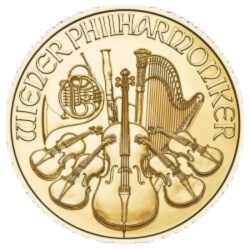
The reverse depicts eight instruments of the Wiener Philharmoniker: four Vienna violins, viola, cello, double bass, harp, Vienna horn and bassoon. The motif has not changed since 1989 (36 years) — one of the most stable in bullion history. The year 2024 introduced the first significant security update: micro-engraved "W" next to the organ, visible under a 10× loupe. The 2025 vintage is the second production year with this feature.
Münze Österreich's decision to introduce the micro-"W" stemmed from two motivations: response to the growing number of bullion coin counterfeits and aligning the industry standard with Royal Canadian Mint (Bullion DNA 2013) and Royal Mint (animated security features 2021). The letter "W" of approximately 0.15 mm height is located in the field next to the right edge of the organ and allows dealers and collectors to immediately verify authenticity visually, without chemical testing.
Obverse — Great Hall organ of the Vienna Musikverein
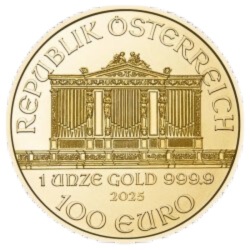
The obverse of the coin depicts the organ of the Great Hall of the Vienna Musikverein (Großer Musikvereinsaal) built by Friedrich Ladegast in 1870. It is a unique concert hall managed by the Gesellschaft der Musikfreunde, where the Vienna Philharmonic Orchestra performs its New Year's Concert broadcast to dozens of countries worldwide.
Around the organ are the inscriptions "REPUBLIK ÖSTERREICH" as well as the face value "100 EURO" and the year of strike ("2025"). Since 2024, in the field next to the right edge of the organ a laser-micro-engraved letter "W" has been struck — symbol of the Vienna Mint and security element visible under 10× loupe. Thomas Pesendorfer as chief engraver of Münze Österreich oversaw both design versions (1989 and the update with micro-"W" in 2024).
Reverse — eight instruments of Wiener Philharmoniker
The reverse of the coin depicts eight orchestral instruments in a composition created by Thomas Pesendorfer in 1989: four Vienna violins (Wiener Geigen), viola, cello, double bass, harp, Vienna horn (Wiener Horn) and bassoon. Each of the instruments represents a specific section of the Vienna Philharmonic Orchestra, one of the world's oldest symphony orchestras (founded 1842).
Around the instruments are the inscriptions "WIENER PHILHARMONIKER" and "1 UNZE GOLD 999.9". The design of the instruments is precisely reproduced — from the spikes of the Vienna horn to the strings of the harp. The absence of a monarch's portrait on the obverse and absence of a national motif on the reverse makes the Philharmonic one of the most "cultural" designs among bullion classics — a coin dedicated to the Austrian musical tradition rather than politics.
Since 2024, the lower part of the reverse contains additional micro-security features. The combination of Pesendorfer's classic design (1989) with the modern micro-"W" (2024) makes Philharmonic 2025 a coin combining 36 years of visual tradition with the current industry security standard.
What to look for when buying 1 oz Vienna Philharmonic 2025?
First: under a 10× loupe verify the micro-engraved "W" in the field next to the right edge of the organ. The letter of approximately 0.15 mm height is invisible to the naked eye. The 2025 vintage is the second year with this feature (first — 2024). Lack of "W" or incorrectly executed letter may indicate counterfeit, despite the visible 2025 date on the reverse.
Second: diameter 37 mm is the largest among 1 oz classics. The coin is noticeably thinner (2.0 mm) and wider than Maple Leaf (30 mm × 2.87 mm) or Krugerrand (32.77 mm × 2.84 mm). This makes Philharmonics visually attractive, but requires more space in a case or safe — worth considering when planning storage of larger numbers of coins.
Third: the 2025 vintage is the second vintage with micro-"W" — it serves as a bridge between the debut 2024 (premiere of the security feature) and subsequent vintages. For an accumulation strategy (goal: maximum Au mass) the current vintage is mathematically most efficient. For collectors of vintage series with security "W" — 2024 + 2025 are currently the first two positions of the series.
Fourth: Philharmonics are delivered without factory blister (unlike Maple Leaf), in individual capsule or without capsule. The 999.9 fineness means metal softness — the coin is worth storing in a numismatic capsule to reduce the risk of micro-scratches and fingerprints, which may lower the resale price.
Why GoldInvest24?
- Manufacturers with LBMA Good Delivery accreditation — Münze Österreich (since 2008), Royal Canadian Mint, Royal Mint, Rand Refinery, PAMP Suisse
- Full range of formats — from 1 g to 1 kg in bars and coins from 1/25 oz to 1 oz in multiple series
- Product descriptions in three language versions (PL/DE/EN) with concrete technical specifications and historical data
- Access to current precious metals prices on LBMA updated in real time
- Portfolio supplementation with categories gold investment coins, gold bullion bars, silver investment coins and silver bullion bars
Comparison of 5 coins and bars from the 1 oz package
| Feature |
Philharmonic |
Maple Leaf |
Britannia |
Krugerrand |
PAMP Fortuna |
| Manufacturer |
Münze Österreich |
Royal Canadian Mint |
Royal Mint |
Rand Refinery |
PAMP Suisse |
| Fineness |
999.9 |
999.9 |
999.9 |
916.7 (22 kt) |
999.9 |
| Diameter |
37.0 mm |
30.0 mm |
32.69 mm |
32.77 mm |
24×41 mm |
| Accreditation |
LBMA since 2008 |
LBMA since 1980 |
LBMA since 1750, CGT-free UK |
LBMA since 1965 |
LBMA since 1986 |
| Security |
Micro-"W" since 2024 |
Bullion DNA + app |
4 optical tiers |
none (Crown Gold) |
CertiPAMP + Veriscan |
Frequently asked questions (FAQ)
What characterizes 1 oz Vienna Philharmonic 2025?
It is an Austrian bullion coin from Münze Österreich with 999.9/1000 fineness and 31.103 g net gold, diameter 37 mm and face value 100 EUR. The 2025 vintage is the second production year with micro-engraved "W" introduced in 2024. Motif of the Great Hall organ of the Vienna Musikverein (obverse) and eight orchestral instruments (reverse) by Thomas Pesendorfer from 1989.
What are the fineness and weight of the Vienna Philharmonic 1 oz coin?
The fineness is 999.9/1000 (.9999, 24 karat), net gold weight 31.103 g (1.000 troy oz). Diameter 37.0 mm (largest among 1 oz bullion classics), thickness 2.0 mm. Philharmonics reached 999.9 fineness in 1989 (seven years after Maple Leaf, which did it first in 1982).
Who designed the organ motif on the obverse?
The obverse (organ of the Vienna Musikverein Great Hall) and reverse (eight instruments of Wiener Philharmoniker) were designed by Thomas Pesendorfer — chief engraver of Münze Österreich — in 1989. The design has not changed in 36 years. Since 2024, a laser-micro-engraved letter "W" has been added in the field next to the organ as a security element.
Vienna Philharmonic 1 oz vs Maple Leaf 1 oz — which to choose?
Both coins have 999.9 fineness and 31.103 g weight. Philharmonics have a larger diameter (37 mm vs 30 mm) and micro-engraved "W" (since 2024, no verification app). Maple Leaf has the full Bullion DNA system with a mobile app and the Charles III portrait. Face value Philharmonic 100 EUR (Eurozone), Maple Leaf 50 CAD.
Who is Vienna Philharmonic 1 oz a good choice for?
Vienna Philharmonic 1 oz is a classic gold portfolio position for those who value the European bullion tradition and EUR face value. It works as a base for a long-term portfolio, a unit of a regular purchase strategy (DCA), and since 2024 also as a collector position for vintage series with security "W".
Are Vienna Philharmonics VAT-exempt in the EU?
YES — the 999.9/1000 fineness significantly exceeds the minimum 995/1000 required for VAT exemption on investment gold (EU Directive 98/80/EC). The exemption status applies in all EU member states.
How to buy Vienna Philharmonic 1 oz at GoldInvest24?
Vienna Philharmonic 1 oz 2025 is in the gold investment coins category of GoldInvest24, the price is linked to the current LBMA precious metals prices. Each coin is verified visually for the micro-engraved "W" before shipping.
The price of 1 oz Vienna Philharmonic 2025 is updated in real time and linked to LBMA precious metals prices.
![[{[item.product.name]}]]([{[item.product.photo.url]}] 75w)