2 Rand South Africa Springbok (1961-1983) — historic gold coin of the Republic of South Africa in the Sovereign specification, direct predecessor of the Krugerrand
the numismatic market until 1983. The state of preservation (PCGS/NGC grading) affects the markup — for the bullion strategy a VF-EF condition is acceptable, for the collector strategy MS-65 or higher is preferred.
Check the variant — Mint State (BU, business strike) vs Proof. Most 2-rand coins are Mint State (circulating strike), but some years (especially numismatic sets) contain Proof variants with mirrored background and matte relief. Proofs have a higher collector markup over spot (typically 15-30% over spot), but also a limited mintage. For a buying strategy focused on bullion, Mint State is preferred (lower margin, identical bullion weight).
The market margin on the 2-rand coin typically holds in the range of 5-10% over spot — higher than on mass bullion coins (Krugerrand typically 4-7%) due to historic status and smaller production scale, but lower than on rare collector years of the Sovereign or Double Eagle. For buyers seeking historic gold with Sovereign specification (0.9167) with South African character (Jan van Riebeeck, springbok), the 2 rand offers an optimal balance of price and uniqueness.
Why GoldInvest24
- Full offer of historic South African and world gold coins: our catalogue features not only the 2 Rand Springbok, but also modern Krugerrands (1 oz, 1/2, 1/4, 1/10 oz, silver and platinum) and other great historic coins — the American Double Eagle, the German 20 Marks, the Dutch 10 Guilders, the Mexican 50 Peso Centenario. A full cross-section allows building a balanced portfolio of South African gold (historic and modern) and world gold.
- South African Mint (Pretoria) — history since 1923: the mint, established in 1923 in Pretoria (as a branch of the Royal Mint in London), has been striking coins for the South African market for 100 years. Pretoria is one of the oldest mints in the southern hemisphere and the main producer of the Krugerrand — the most recognisable bullion coin of the 20th-21st century. The 2 rand is a historic artefact of the beginnings of independent South African numismatics.
- PL / DE / EN language versions: full technical descriptions and specifications in three languages for convenient service of the Polish, German and international markets — particularly valuable for South African historic coins with Afrikaans (SUID-AFRIKA) and English (SOUTH AFRICA, springbok, Crown Gold) terminology.
- Current precious-metals quotes: spot data for comparing offer prices with current market valuation — check the current precious-metals prices before purchase to assess the effective markup on the 2-rand coin relative to the current gold price.
- Full precious-metal categories in one shop: access to gold bullion coins, bars, silver, platinum and palladium — all from a single customer account, with full PL/DE/EN support and unified ordering policy across all product categories.
Comparison of 5 great historic world gold coins of package 107
| Feature |
20 USD Double Eagle Liberty |
2 Rand RSA Springbok |
20 Marks Wilhelm I |
10 Guilders Netherlands |
50 Peso Centenario |
| Country |
USA |
South Africa |
German Empire |
Netherlands |
Mexico |
| Mintage years |
1850-1907 |
1961-1983 |
1871-1888 |
1875-1933 |
1921-1947 (restrike 1949-1972) |
| Pure gold |
30.0926 g |
7.3224 g |
7.1685 g |
6.048 g |
37.5000 g |
| Gross mass |
33.4362 g |
7.9881 g |
7.9650 g |
6.720 g |
41.6666 g |
| Fineness |
0.900 |
0.9167 |
0.900 |
0.900 |
0.900 |
| Diameter |
34.0 mm |
22.07 mm |
22.5 mm |
22.5 mm |
37.0 mm |
| Obverse |
Liberty Head |
Jan van Riebeeck |
Wilhelm I |
Wilhelm III / Wilhelmina |
Angel of Independence |
| Reverse |
Bald Eagle |
Springbok |
Reichsadler |
Heraldic shield |
Águila Mexicana |
| Typical margin over spot |
6-12% |
5-10% |
4-9% |
4-8% |
3-7% |
See the entire gold bullion coins category available at GoldInvest24.
FAQ — common questions about the 2 Rand South Africa Springbok
What is the 2 Rand South Africa Springbok?
The 2 Rand South Africa Springbok is a historic gold coin of the Republic of South Africa, struck by the South African Mint in Pretoria from 1961 to 1983 — the first gold coin of South Africa as an independent republic (after exiting the British Commonwealth in 1961). Gross mass 7.9881 g, pure gold 7.3224 g, 0.9167 fineness (Crown Gold 22 carats) — IDENTICAL to the British Sovereign. 22.07 mm diameter. Obverse: portrait of Jan van Riebeeck (founder of Cape Town 1652). Reverse: Springbok (national animal of South Africa). Direct predecessor of the 1 oz Krugerrand (1967).
What is the technical specification of the 2 Rand South Africa?
Gross mass 7.9881 g (= identical to Sovereign), pure-gold mass 7.3224 g (= identical to Sovereign), 0.9167 fineness (Crown Gold, 22 carats), alloy Au 91.67% + Cu 8.33%, 22.07 mm diameter, approx. 1.7 mm thickness. Manufacturer: South African Mint (Pretoria). Obverse: Jan van Riebeeck, SUID-AFRIKA SOUTH AFRICA. Reverse: Springbok (Antidorcas marsupialis), 2 RAND, year. Legal tender South Africa 1961-1983.
What is the history of the 2 Rand South Africa Springbok?
Introduced 1961 — the year South Africa exited the British Commonwealth (Republic Day, 31 May 1961). Specification deliberately identical to the Sovereign (0.9167) to maintain compatibility with the Commonwealth gold system. Struck 1961-1983 at the South African Mint (Pretoria) — the same mint that had been striking British Sovereigns since 1923. 1967 — introduction of the Krugerrand (1 oz, 0.9167) as the main South African bullion coin, the 2 rand gradually phased out. Total mintage 22 years: approximately 1.5-2 million pieces.
Does the 2 Rand have an identical specification to the British Sovereign?
YES — the 2 Rand South Africa and the British Sovereign have an IDENTICAL specification: gross mass 7.9881 g, pure gold 7.3224 g, 0.9167 fineness (Crown Gold, 22 carats), 22.07 mm diameter. The identity was deliberate: after South Africa's exit from the Commonwealth in 1961, the new Republic retained compatibility with the Commonwealth gold system to facilitate coin exchange with Great Britain and other Sovereign-system countries. Differences: face value (2 rand RSA vs 1 pound UK) and design (Jan van Riebeeck/Springbok vs Saint George/Monarch).
For whom is the 2 Rand South Africa Springbok a practical choice?
For buyers valuing historic South African gold and the Sovereign specification (0.9167 Crown Gold). For building a Commonwealth gold portfolio — 2 rand alongside British Sovereigns, Australian Sovereigns (1855-1931), Canadian and Indian issues. For numismatic collectors seeking the pre-Krugerrand prototype (1961-1967). For a diversified portfolio of historic world gold — 2 rand as the South African representation alongside USA, Germany, France, Mexico.
What is the VAT, CGT and IRA status of the 2 Rand South Africa Springbok?
VAT in the EU — EXEMPT (historic legal-tender coin, 0.9167 fineness ≥ 0.900, struck after 1800, market price ≤180% of gold value — meets EU Directive 2006/112/EC Art. 344 and Polish VAT Act Art. 122). CGT-free in the UK — NO (CGT-free status applies only to British legal tender — Sovereign, Britannia, Lunar UK). IRA-eligible in the USA — NO (the IRS admits only American coins listed — American Gold Eagle, American Buffalo and selected modern bullion; historic coins, including the 2 Rand, are NOT among the approved).
How do I buy the 2 Rand South Africa Springbok at GoldInvest24?
Place an order in our shop with access to the full gold bullion coins category, the complete offer of great historic world gold coins (Double Eagle USA, 50 Peso Mexico, 20 Marks Germany, 10 Guilders Netherlands, 2 Rand RSA) and modern Krugerrands (1, 1/2, 1/4, 1/10 oz, silver and platinum). Check the current gold quotes to compare the markup over spot against the current spot price. Descriptions and specifications are available in PL / DE / EN.
The 2 Rand South Africa Springbok gold coin is the first gold coin of the Republic of South Africa (after the country's exit from the British Commonwealth in 1961), struck by the South African Mint in Pretoria from 1961 to 1983, with a gross mass of 7.9881 g, a pure-gold mass of 7.3224 g, fineness of 0.9167 (22 carats Crown Gold) — identical to the British Sovereign specification — diameter of 22.07 mm and a face value of 2 rand as historic legal tender of the Republic of South Africa. The obverse features the portrait of Jan van Riebeeck (1619-1677), founder of the Dutch colony in Cape Town in 1652; the reverse — the springbok (Antidorcas marsupialis), the national animal of South Africa. The coin is the direct predecessor of the 1 oz Krugerrand (1967), based on the identical Sovereign specification to maintain compatibility with the Commonwealth gold system. Typically 5-10% over spot. VAT-exempt in the EU as a historic legal-tender coin with a fineness ≥0.900 struck after 1800.
Technical specification
| Parameter |
Value |
| Manufacturer |
South African Mint (Pretoria) — South African Mint |
| Series |
2 Rand Republic of South Africa — Pre-Krugerrand |
| Mintage years |
1961-1983 (replaced by Krugerrand 1967, but still struck until 1983) |
| Standard |
Crown Gold 0.9167 — IDENTICAL to British Sovereign (since 1817) |
| Gross mass |
7.9881 g (= identical to Sovereign) |
| Pure gold mass |
7.3224 g (= identical to Sovereign) |
| Fineness |
0.9167 (22 carats, Crown Gold) |
| Alloy |
Au 91.67% + Cu 8.33% |
| Diameter |
22.07 mm |
| Thickness |
approx. 1.7 mm |
| Face value |
2 rand (historic legal tender South Africa, 1 rand = 100 cents) |
| Obverse |
Portrait of Jan van Riebeeck (founder of Cape Town 1652) — SUID-AFRIKA SOUTH AFRICA |
| Reverse |
Springbok (Antidorcas marsupialis) — national animal of South Africa, 2 RAND, year |
| Historic status |
Legal tender South Africa 1961-1983, direct predecessor of the 1 oz Krugerrand |
| VAT in the EU |
Exempt (legal-tender coin, 0.9167 fineness, struck after 1800, EU Directive 2006/112/EC Art. 344) |
| UK status |
NOT CGT-free (CGT exemption applies only to British legal tender) |
| USA status |
NOT IRA-eligible (historic coins are not on the IRS-approved list) |
| Packaging |
Individual protective capsule |
Why 2 Rand South Africa Springbok deserves a place in your portfolio
- Identical specification to the British Sovereign — Crown Gold 0.9167: the 2 rand contains 7.3224 g of pure gold at 0.9167 fineness (22 carats Crown Gold) — an identical specification to the British Sovereign struck since 1817. The identity of specification was deliberate: after South Africa's exit from the British Commonwealth in 1961, the new Republic of South Africa retained compatibility with the Commonwealth gold system to facilitate coin exchange with Great Britain and other Sovereign-system countries.
- First gold coin of the Republic of South Africa — historic 1961 artefact: the 2 rand was introduced in 1961 — the same year South Africa left the British Commonwealth (31 May 1961, Republic Day) and declared itself an independent republic. Earlier gold coins struck in South Africa (from 1923 at the South African Mint in Pretoria) were British Sovereigns with the head of George V, Edward VIII and Elizabeth II. The 2 rand is the first coin with the portrait of a historic South African figure (Jan van Riebeeck) instead of a British monarch.
- Direct predecessor of the 1 oz Krugerrand (1967) — pre-Krugerrand history: the 2 rand was struck until 1983, but from 1967 — the introduction of the Krugerrand — it played a secondary role. The Krugerrand was designed as South Africa's response to Western economic sanctions against apartheid and the need to create a recognisable, standardised bullion coin for the international market. The 2 rand became the historic foundation of the Krugerrand — the same 0.9167 fineness, the same Crown Gold standard, the identical mint (Pretoria).
- Jan van Riebeeck (1619-1677) — historic symbol of the founding of the Dutch colony of Cape Town: the obverse features the portrait of the first governor of the Dutch East India Company at the Cape of Good Hope, who in 1652 founded Cape Town as a supply station for Dutch ships sailing to India. Van Riebeeck is a figure of multiple significance: for the Dutch — founder of the first European colony in sub-Saharan Africa; for Afrikaners (descendants of Dutch colonists) — symbol of South Africa's historic roots; for the indigenous Khoikhoi inhabitants — beginning of European colonisation.
- Springbok — national animal of South Africa and symbol of South African identity: the reverse features the springbok (Antidorcas marsupialis) — a leaping antelope from the South African semi-deserts of the Karoo, which became the national animal of South Africa and a symbol of South African sport (the Springboks rugby team). The springbok design on the 2-rand coin was conceived to emphasise the national identity of the new Republic — in contrast to the British imperial symbols (lion, crown) on earlier Sovereigns struck in Pretoria.
History of the 2 Rand South Africa (1961-1983) — the first gold coin of the Republic of South Africa
The 2 rand gold coin was introduced in 1961 — the year the Republic of South Africa left the British Commonwealth (31 May 1961, Republic Day) and declared itself an independent republic under President Charles Robberts Swart. The introduction of the new currency (rand replacing the South African pound) required the striking of new coins — including a gold coin with the face value of 2 rand (= 1 South African pound in the old system). The South African Mint in Pretoria, which since 1923 had struck British Sovereigns for the Commonwealth market, received the order to produce the new South African coin.
The specification of the 2-rand coin was deliberately matched to the British Sovereign: 7.9881 g gross, 7.3224 g pure gold, 0.9167 fineness (22 carats Crown Gold), 22.07 mm diameter. The identity with the Sovereign had three justifications: (1) maintaining compatibility with the Commonwealth gold system to facilitate exchange with Great Britain and other British countries; (2) using the existing Pretoria mint infrastructure that had been striking Sovereigns in the same specification since 1923; (3) symbolic continuation of the South African tradition of striking gold coins to the British standard.
In 1967 the Pretoria mint introduced the Krugerrand — a 1-ounce gold coin with a specification of 33.9305 g gross at 0.9167 fineness and a pure gold content of 1 troy oz (31.1035 g). The Krugerrand was designed as South Africa's response to Western economic sanctions against apartheid policy and the need to create a recognisable, standardised bullion coin for the international market. The Krugerrand quickly gained global popularity — in the 1970s it accounted for 90% of the global bullion coin market. The 2 rand was struck in parallel until 1983, but gradually phased out in favour of the Krugerrand as the main bullion coin.
The 2 rand was struck in mint-state (BU, business strike) and Proof variants in special numismatic sets. Earlier issues 1961-1972 contained only the Jan van Riebeeck portrait as standard; in later years (1973-1983) the design remained unchanged. The total mintage of the 2-rand coin in its 22-year production is estimated at approximately 1.5-2 million pieces — significantly less than the Krugerrand (over 50 million pieces since 1967), which makes the 2 rand a historically more valuable and collectible coin.
After production ended in 1983, the South African Mint continued to strike the Krugerrand as its main gold coin, later introducing fractional 1/2, 1/4 and 1/10 oz Krugerrand versions (1980), the silver Krugerrand (2017) and the platinum Krugerrand (2018). The 2 rand remained a historic symbol of the beginnings of independent South African numismatics, and at the same time a lasting example of the international continuation of the British Sovereign standard (Crown Gold 0.9167) — used since 1817 (Sir Isaac Newton's reform) by all colonies and dominions of the British Empire and by independent post-British states.
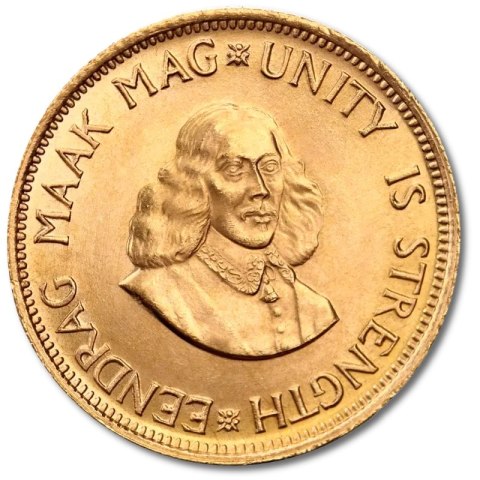
Obverse — portrait of Jan van Riebeeck, founder of Cape Town (1652)
The obverse of the 2 Rand South Africa coin features the portrait of Jan van Riebeeck (1619-1677) — first governor of the Dutch East India Company (Vereenigde Oostindische Compagnie, VOC) at the Cape of Good Hope, who in 1652 founded Cape Town as a supply station for Dutch ships sailing to India and the Dutch East Indies. Van Riebeeck is shown in left profile, in mid-17th-century dress — with moustache and lace collar characteristic of the Dutch merchant nobility of the Dutch Golden Age. Around the portrait is the inscription SUID-AFRIKA (Afrikaans) and SOUTH AFRICA (English) — the official bilingual name of the country (in accordance with the constitutional status of bilingualism).
Jan van Riebeeck (1619-1677) was born in Culemborg in the Netherlands and began his career as a surgeon's assistant at the East India Company. In 1651 he was appointed first governor of the new VOC colony at the Cape of Good Hope — the goal was to organise a supply station (Refreshment Station) for Dutch ships sailing to the East Indies. Van Riebeeck arrived at the Cape on 6 April 1652 with 90 settlers and founded Fort Goede Hoop (Fortress of Good Hope) — the first permanent European settlement in southern Africa. He served as governor until 1662, after which he took a position in the East Indies (Batavia).
The figure of van Riebeeck is a multiple historic symbol of South Africa — for the descendants of Dutch settlers (Afrikaners, Boers) he is the founder of white European culture in southern Africa, the foundation of Boer national identity and their territorial claims to the region. In the apartheid era (1948-1994) van Riebeeck was officially celebrated as a national hero of South Africa — Founder's Day (Geloftedag, 6 April) commemorated his arrival in 1652. After the end of apartheid in 1994, the historic assessment of van Riebeeck was revised — from the perspective of the indigenous Khoikhoi and San his arrival initiated centuries of European colonisation, land dispossession and discrimination. Despite the changed historic assessment, van Riebeeck remains a historic figure of fundamental importance for the history of South Africa — and the 2-rand coin with his portrait is an important numismatic artefact of the 1961-1983 era.
The inscription SUID-AFRIKA SOUTH AFRICA on the coin reflects the official bilingual status of South Africa before 1994 (Afrikaans and English as the two official state languages). After the end of apartheid and the adoption of the new constitution in 1996, South Africa recognised 11 official languages, but in the 1961-1983 era (i.e. throughout the entire 2-rand production) Afrikaans-English bilingualism was the standard. The letters SUID-AFRIKA (Afrikaans) and SOUTH AFRICA (English) on the coin reflect this bilingualism.
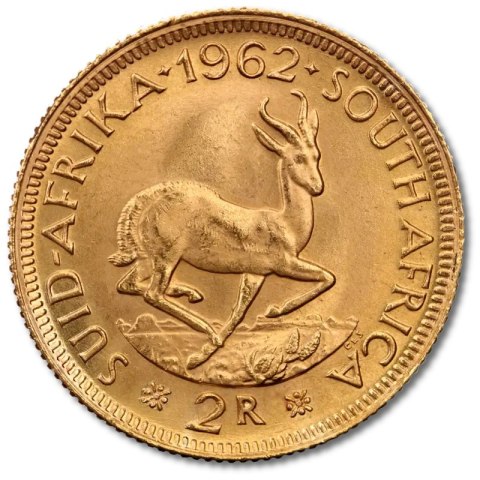
Reverse — Springbok (Antidorcas marsupialis), national animal of South Africa
The reverse of the 2 Rand South Africa coin features the springbok (Antidorcas marsupialis) — a leaping antelope from the South African semi-deserts of the Karoo and the Great Kalahari Desert. The springbok is shown in a typical running posture, with head turned left, slightly bent neck and the characteristic dorsal skin fold (which unfolds in “pronking” — the characteristic vertical jumping typical of the springbok). Around the animal are the denomination 2 RAND and the year of mintage.
The springbok is the national animal of the Republic of South Africa — a national symbol established in the 19th century by Dutch colonists (Boers) and continued by South Africa after independence in 1961. This antelope is characterised by unique behaviour called “pronking” (or “stotting”) — vertical jumping on all four legs simultaneously, with head lowered and back arched. “Pronking” is a form of signalling to predators (“I see you, pursuit attempt is pointless”) and occurs only in springbok and a few other antelopes.
The Republic of South Africa rugby team — the Springboks — owes its name and emblem to this antelope. Founded in 1891, the Springboks team is one of the most successful rugby teams in the world (world champions in 1995, 2007, 2019, 2023). After the end of apartheid in 1994, the new South African government under President Nelson Mandela retained the name “Springboks” as a symbol of national reconciliation — Mandela personally supported the team during the 1995 Rugby World Cup (won by South Africa), which became a symbolic moment of post-apartheid integration.
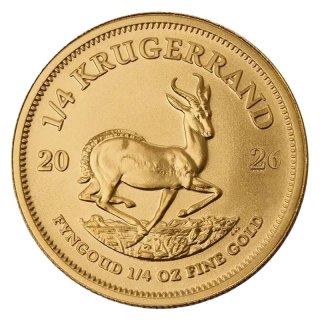
The springbok design on the 2-rand coin was conceived to emphasise the national identity of the new Republic of South Africa — in contrast to British imperial symbols (lion, crown, Saint George) on earlier Sovereigns struck in Pretoria (1923-1932). The springbok is also the motif on the reverse of the later Krugerrand (1967+), where it represents the national animal of South Africa — the Krugerrand presents the portrait of President Paul Kruger on the obverse and the springbok on the reverse, maintaining visual continuity with the 2-rand pre-Krugerrand coin 1961-1967.
What to look out for when buying
Check authenticity and specification — the 2 rand weighs 7.9881 g gross, contains 7.3224 g of pure gold at 0.9167 fineness (Crown Gold 22 carats), 22.07 mm diameter. The specification is IDENTICAL to the British Sovereign (since 1817) — which allows easy verification of weight and dimensions. Counterfeits of the 2-rand coin are known on the market — particularly copies from the Middle East with lower fineness (sometimes 0.750-0.850 instead of 0.9167). Purchase documents from a certified gold dealer are important for later resale.
Check the year and state of preservation — the 2 rand had a 22-year production period (1961-1983) with different mintages in individual years. The highest mintages were in the early years (1961-1965), when the 2 rand was the main South African gold coin before the introduction of the Krugerrand (1967). After 1967 mintages decreased, but production continued for
![[{[item.product.name]}]]([{[item.product.photo.url]}] 75w)