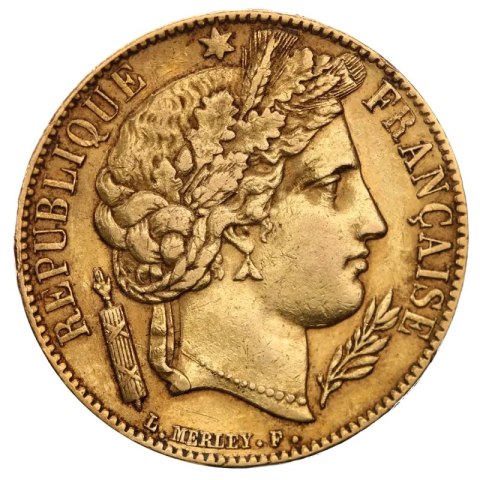
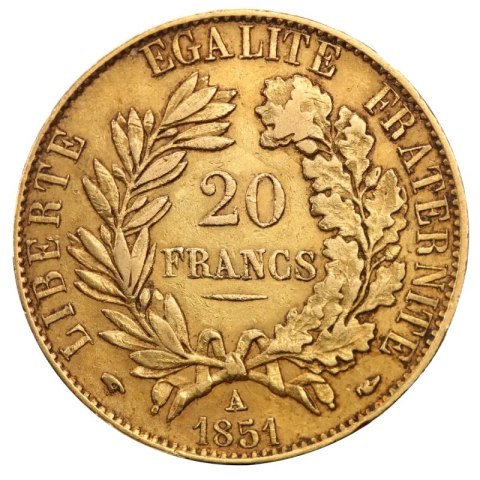
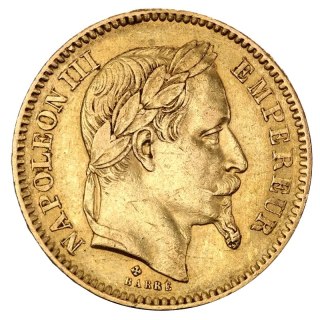
20 French Francs Cérès Second French Republic (1848-1851) — short issue of the Second French Republic with the portrait of the Roman goddess of fertility and predecessor of the Latin Monetary Union standard
The 20 French Francs Cérès gold coin is a historic French 20-franc piece of the Second French Republic (1848-1851), struck at the Monnaie de Paris in a very short 4-year issue — with a gross mass of 6.4516 g, a pure-gold mass of 5.80645 g, a 0.900 fineness, a 21.0 mm diameter and a face value of 20 French francs as legal tender of the Second Republic. The obverse features the head of Cérès — the Roman goddess of fertility and agriculture — with a crown of grain ears and the inscription REPUBLIQUE FRANÇAISE, the reverse the face value 20 FRANCS in a laurel-oak wreath with the year of striking. The designer of the pattern is Louis Merley (1815-1883), French medallist of the Paris Mint. The technical specification of 6.4516 g gross / 5.80645 g pure gold / 0.900 fineness is pre-LMU — a direct predecessor of the Latin Monetary Union standard which France exported to all of Europe through the treaty of 23.12.1865. The coin is VAT-exempt in the EU as a legal-tender coin with 0.900 fineness struck after 1800, with a typical market markup of 5-10% over spot — higher than classic LMU 20F coins due to the very short issue (only 4 vintages 1848-1851) and the historic status of the Second French Republic.
Technical specification
| Parameter |
Value |
| Manufacturer |
Monnaie de Paris (France, mintmark “A” — Paris) |
| Series |
20 Francs Cérès — Second French Republic |
| Mintage years |
1848-1851 (4 vintages of the Second French Republic) |
| Standard |
Pre-LMU 20F (French germinal franc 1803, the prototype for LMU 1865) |
| Gross mass |
6.4516 g (gold + copper) |
| Pure gold mass |
5.80645 g |
| Fineness |
0.900 fineness (Crown-Gold-style alloy) |
| Alloy |
Au 90% + Cu 10% |
| Diameter |
21.0 mm |
| Thickness |
approx. 1.3 mm |
| Face value |
20 French francs (historic legal tender of the Second Republic) |
| Obverse |
Head of Cérès in a crown of grain ears, REPUBLIQUE FRANÇAISE — Louis Merley |
| Reverse |
Face value 20 FRANCS in a laurel-oak wreath, year |
| Designer |
Louis Merley (1815-1883) — French medallist of the Paris Mint |
| Historic status |
Legal tender of the Second French Republic (1848-1851) |
| VAT in the EU |
Exempt (legal-tender coin, 0.900 fineness = minimum, struck after 1800, EU Directive 2006/112/EC Art. 344) |
| UK status |
NOT CGT-free (CGT exemption applies only to British legal tender) |
| USA status |
NOT IRA-eligible (IRS admits only American coins and selected bullion) |
| Packaging |
Individual protective capsule |
Why 20 French Francs Cérès Second Republic deserves a place in your portfolio
- Very short issue — only 4 vintages (1848-1851), pre-LMU 20F: 20 French Francs Cérès of the Second French Republic was struck exclusively in 4 years (1848, 1849, 1850, 1851) — a very short series compared to the 16-year production of 20F Marianne and Rooster (1899-1914) or the 18-year reign of Napoleon III (1853-1870). The short issue means relatively limited availability on the secondary market and a higher numismatic margin over spot (5-10% over spot) relative to mass-produced LMU 20F coins.
- Pre-LMU standard 6.4516 g gross, 5.80645 g pure gold — predecessor of the Latin Monetary Union: the technical specification of 20F Cérès (6.4516 g gross, 5.80645 g pure gold, 0.900 fineness) is identical to the later Latin Monetary Union standard (1865) — the French 20-franc coin existed from the germinal franc of Napoleon I (1803), and the LMU merely codified this existing French pattern as an international standard. 20F Cérès is a direct ancestor of all later LMU 20F coins (Vreneli, Napoleon III, Angel, Helvetia, Leopold II) — a purely French 20F before the union.
- Historic artefact of the Second French Republic (1848-1851): 20F Cérès is one of very few gold coins of the Second French Republic — the short epoch between the overthrow of Louis Philippe I (February 1848) and the coup d'état of Louis Napoleon Bonaparte (December 1851). The Second Republic has not existed for over 170 years — owning a 20F Cérès is a physical connection with the era of the February Revolution of 1848, the first universal male suffrage in France and the short republican experiment between two monarchies (July Monarchy 1830-1848 and Second Empire 1852-1870).
- Designer Louis Merley — medallist of the Paris Mint in the 19th century: Louis Merley (1815-1883) was a French medallist and engraver of the Paris Mint, the author of the Cérès design for the 20F of the Second French Republic. The choice of Cérès — the Roman goddess of fertility and agriculture — as the symbol of the new republic was deliberate: the goddess with a crown of grain ears represents the agricultural character of 19th-century France (dominance of agriculture over industry), the fertility of French soil and the peaceful character of the republic (Cérès is the goddess of peace and abundance, not war).
- 5-10% over spot — higher than mass-produced LMU 20F, lower than rare collector pieces: 20F Cérès has a typical margin of 5-10% over spot — higher than mass-struck LMU 20F (Vreneli 2-5%, Marianne and Rooster 3-6%) due to the short 4-year issue and the historic status of the Second Republic, but lower than rare collector varieties (e.g. specific vintages in UNC grades may have a 30-100% markup). For a buyer seeking a balance between historic value and accessible bullion, 20F Cérès offers the optimal ratio.
History of 20 French Francs Cérès (1848-1851) — short issue of the Second French Republic
The Second French Republic was proclaimed on 25 February 1848 after the February Revolution — mass Parisian protests (22-24 February 1848) which led to the abdication of King Louis Philippe I of the Orléans dynasty (July Monarchy, 1830-1848). The revolution was part of the broader Spring of Nations of 1848 — a wave of revolutions in Europe against monarchical absolutism and the conservatism of the Congress of Vienna (1815). The Second Republic was the second republic in French history — the first existed in 1792-1804 (from the proclamation of the First Republic by the National Convention to the coronation of Napoleon I).
The Second Republic introduced several revolutionary socio-political changes: universal male suffrage (from April 1848 — the first in continental Europe, for men ≥21 years old), abolition of the death penalty for political crimes, abolition of slavery in all French colonies (27 April 1848 — the second time after 1794, when Napoleon restored slavery in 1802), 10-hour working day in Paris. The Constitution of the Second Republic, adopted on 4 November 1848, established the National Assembly (unicameral parliament) and the President of the Republic elected by universal suffrage.
The presidential election of 10 December 1848 was won by Louis Napoleon Bonaparte — nephew of Napoleon I — obtaining 5.5 million votes (74.2% of all votes cast). Bonaparte exploited the strong cult of his uncle (Napoleon I was considered a hero of France, despite the defeat of 1815) as well as the concerns of the bourgeoisie about the socialist radicalism of the Red Republicans (Louis Blanc, Pierre Proudhon). During his 3-year presidency, Bonaparte consistently strengthened his power at the expense of the National Assembly, aiming to transform the republic into a new imperial monarchy modelled on his uncle.
Bonaparte carried out the coup d'état on 2 December 1851 — on the anniversary of Napoleon I's coronation (1804) and the Battle of Austerlitz (1805). The Paris army under the command of General Saint-Arnaud occupied the buildings of the National Assembly, arresting opposition deputies. Bonaparte announced the dissolution of the Assembly, the restoration of universal suffrage (repealed in 1850) and a referendum on a new constitution. The plebiscite of 20-21 December 1851 gave Bonaparte 92% Yes votes (with 80% turnout). The Second Republic effectively ended — it formally existed for one more year, until 2 December 1852, when Bonaparte proclaimed himself Emperor Napoleon III (Second French Empire 1852-1870).
20F Cérès was struck during the 4 years of the Second Republic's existence — 1848 (first issue after the February Revolution), 1849, 1850 and 1851 (last issue before Bonaparte's coup). After 1851 — in the period of the short Second Republic Bonaparte-President (December 1851 — December 1852) — 20F were still struck with the image of Louis Napoleon Bonaparte as president, and from 1853 — with the image of Emperor Napoleon III. 20F Cérès from 1848-1851 forms a unique group of coins of the only republican regime between two monarchies of 19th-century France — the short Second Republic, which tried to establish democratic rule between the Orléans July Monarchy and the Bonapartist Second Empire.
Obverse — Head of Cérès in a crown of grain ears by Louis Merley
The obverse of the 20 French Francs Cérès Second Republic coin features the head of Cérès — the Roman goddess of fertility, agriculture, harvest and fertility of the earth — in left profile, with a crown of grain ears (corona spicea) on her head. Cérès's hair falls behind her shoulder in the form of a braid or loose strands. Around the portrait runs the inscription REPUBLIQUE FRANÇAISE (French Republic) in a semicircle from the top. The artist's signature “MERLEY” is visible under the portrait, under Cérès's arm.
The obverse designer is Louis Merley (1815-1883) — French medallist and engraver of the Paris Mint (Monnaie de Paris), the author of numerous commemorative medals and circulating coins of the Second Republic and the Second French Empire. Merley was trained at the Paris Mint under Augustin Dupré and Tiolier — outstanding French medallists at the turn of the 18th and 19th centuries — and continued the classical French medal tradition (allegorical portraits in the neoclassical style, inspiration from ancient Greek and Roman numismatics). The choice of Cérès for the obverse of the 20F of the Second French Republic was a politically meaningful decision — the goddess of fertility symbolised the agricultural character of 19th-century France (75% of the population lived from agriculture) and the peaceful character of the republic.
Cérès (Gr. Demeter) was the Roman goddess of fertility, agriculture, harvest, grain and fertility of the earth — one of the most important goddesses of the Roman pantheon, patroness of farmers and rural communities. In Roman mythology, Cérès is the mother of Proserpina (Gr. Persephone) — the goddess of spring — and her cyclical search for her daughter after the abduction by Pluto (Hades) explains the cycle of seasons. The attributes of Cérès are the crown of grain ears (corona spicea), the harvest sickle, the basket of fruits and flowers (cornucopia) and the torch (symbol of searching for the daughter). On the 20F Cérès only the crown of grain ears is visible — the most recognisable attribute of the goddess.
The choice of Cérès as the allegory of the Second French Republic was a considered ideological decision — in contrast to Marianne (the allegory of the Republic in a Phrygian cap, symbolising freedom and the French Revolution of 1789), Cérès represents the peaceful, agricultural character of France and the abundance of harvests of French soil. The Second Republic of 1848 — in contrast to the First Republic of 1792 (which arose during the bloody French Revolution and the coalition wars) — wanted to present itself as a calm, economic, democratic republic without excessive revolutionary rhetoric. Cérès was a well-chosen symbol — goddess of field work, harvest abundance, rural peace — in contrast to Marianne in a Phrygian cap (a direct symbol of the Revolution of 1789).
Reverse — face value 20 FRANCS in a laurel-oak wreath
The reverse of the 20 French Francs Cérès coin features the face value 20 FRANCS in a large, dominant central composition, surrounded by a laurel-oak wreath of laurel branches (on the left) and oak branches (on the right), tied at the bottom with a ribbon. Under the face value appears the year of striking (1848, 1849, 1850 or 1851). The mintmark “A” (Paris) and the symbols of the mint's general engraver are discreetly placed next to the date.
The laurel-oak wreath is a classic European heraldic motif — laurel symbolises victory, fame, peace and poetic perfection (laurel wreaths were placed in ancient Greece on the victors of games and triumphant poets, in Rome — on generals after military victories); the oak symbolises strength, durability, independence and democracy (oaks were sacred trees of the Gallic Druids, and oak wreaths were the Roman corona civica awarded to citizens for civic merits, e.g. for saving the life of another citizen). The laurel-oak combination links military victory (laurel) with civic durability (oak) — a universal heraldic motif of European states since antiquity.
On 20F Cérès the laurel-oak wreath surrounds the face value — this is a classic iconographic solution of French numismatics since the germinal franc of Napoleon I (1803), where the reverse of the 20F featured the face value in a wreath (with variations: laurel-oak, laurel, oak) — continued by subsequent regimes of the 19th century. The Second Republic retained this motif — in contrast to the later Third Republic, which replaced the face value on the reverse with allegories (Angel of Augustin Dupré 1871-1898, Gallic Rooster of Chaplain 1899-1914). 20F Cérès is therefore iconographically the most classic French 20-franc coin of the 19th century — with the dominance of the face value on the reverse and the classical allegorical portrait of the goddess on the obverse.
The year of striking under the face value is the most important distinguishing feature between the 4 vintages of the series: 1848 (first issue after the February Revolution, highest mintage), 1849, 1850 and 1851 (last issue before Bonaparte's coup). All vintages have an identical technical specification — differences in collector value result from mintages (1848 the highest due to the need to replenish circulation after the February Revolution, 1851 low due to political unrest before the coup) and condition (better grades — higher markup). The “A” mintmark indicates exclusively the Monnaie de Paris — 20F Cérès was struck only in the capital mint.
What to look out for when buying
Check the vintage of the 20F Cérès coin — the issue was conducted for only 4 years (1848-1851), with varying mintages. The highest mintage was the year 1848 (need to replenish circulation after the February Revolution, mass production at the Monnaie de Paris), the lowest — the year 1851 (political unrest, loss of confidence in the germinal franc in the face of mounting Bonaparte-Assembly conflict). The years 1849 and 1850 had moderate mintages. All 4 vintages are available in secondary trade, but 1848 is the most commonly encountered, and 1851 is the rarest and most collectable.
The market margin over spot on 20F Cérès typically holds in the range of 5-10% over spot — higher than on mass-struck LMU 20F (Vreneli 2-5%, Marianne and Rooster 3-6%) due to the very short 4-year issue and the historic status of the Second Republic. The markup over spot may rise for specific rare vintages (1851) or condition grades (AU, UNC) — for fully collectable coins in UNC condition the margin can reach 30-100% over spot. For a buying strategy of accumulating historic gold, mixed years 1848-1851 are optimal — direct access to the gold of the Second Republic with a moderate markup.
Check the mint of striking — all 20F Cérès coins are struck exclusively at the Monnaie de Paris (mintmark “A” — Paris, the only official mint of the Second French Republic). The absence of the “A” mintmark or another mintmark most likely indicates a counterfeit or modern restrike (the Monnaie de Paris has never produced restrikes of 20F Cérès). The Monnaie de Paris preserves the historic register of mintages of each of the 4 vintages 1848-1851, which enables verification of the authenticity of a specific vintage.
Check the condition of the coin and authenticity — 20F Cérès in the 0.900 alloy is harder than pure 999.9 gold, but after 175+ years since striking it retains typical circulation traces: wear, fine scratches, natural surface patina. For a buying strategy, VF (Very Fine) and EF (Extremely Fine) grades are acceptable — sufficient to confirm authenticity and gold content. AU (About Uncirculated) and UNC (Uncirculated) grades are sought after by collectors and have a higher margin. Each coin is delivered in an individual protective capsule to preserve the surface.
Why GoldInvest24
- Full cross-section of coins of European monetary unions of the 19th/20th centuries: in our catalogue you will find all 5 coins of package 108 — 20F Marianne and Rooster (France), 20F Cérès Second Republic (France), 10F Marianne and Rooster (France), 20 Lire Umberto I (Italy), 20 Kroner Frederik VIII (Denmark) — which allows building an LMU + SMU portfolio as a direct reference to 19th-century European monetary integration.
- Short historic series for collectors: 20F Cérès offer in mixed-years format (4 vintages 1848-1851) with a 5-10% markup over spot — a shorter series than mass LMU 20F coins, a higher collector margin, a direct artefact of the Second French Republic. For vintage collectors, specific vintages in AU/UNC grades are also available in the higher price range.
- PL / DE / EN language versions: full technical descriptions and specifications in three languages for convenient service of the Polish, German and international markets — particularly valuable for historic coins with numismatic terminology in three languages (French Ceres, German Ceres, English Ceres — the same Latin name in all European languages).
- Current precious-metals quotes: spot data for comparing offer prices with current market valuation — check the current precious-metals prices before purchase to assess the effective markup on historic pre-LMU coins.
- Full precious-metal categories in one shop: access to gold bullion coins, bars, silver, platinum and palladium — all from a single customer account, with full PL/DE/EN support.
Comparison of 5 coins in package 108 — Marianne and Rooster, Cérès II Rep., 10F Marianne, Umberto I, Frederik VIII
| Feature |
20F Marianne+Rooster (FR) |
20F Cérès II Rep. (FR) |
10F Marianne+Rooster (FR) |
20 Lire Umberto I (IT) |
20 Kroner Frederik VIII (DK) |
| Mintage years |
1899-1914 |
1848-1851 |
1899-1914 |
1879-1897 |
1908-1912 |
| Standard |
LMU 20F |
Pre-LMU 20F |
LMU 10F |
LMU 20F |
SMU 20 Kroner |
| Mint |
Monnaie de Paris (A) |
Monnaie de Paris (A) |
Monnaie de Paris (A) |
Rome Mint (R) |
Copenhagen Mint () |
| Obverse |
Marianne in Phrygian cap |
Cérès with grain crown |
Marianne in Phrygian cap |
Umberto I (bearded) |
Frederik VIII (profile) |
| Designer |
Jules-Clément Chaplain |
Louis Merley |
Jules-Clément Chaplain |
Filippo Speranza |
Heinrich Goldschmidt |
| Gross mass |
6.4516 g |
6.4516 g |
3.2258 g |
6.4516 g |
8.9606 g |
| Pure gold |
5.80645 g |
5.80645 g |
2.9032 g |
5.80645 g |
8.0645 g |
| Fineness |
0.900 |
0.900 |
0.900 |
0.900 |
0.900 |
| Diameter |
21.0 mm |
21.0 mm |
19.0 mm |
21.0 mm |
23.0 mm |
| Typical margin over spot |
3-6% |
5-10% |
8-15% |
5-10% |
6-12% |
See the entire gold bullion coins category available at GoldInvest24.
FAQ — common questions about 20 French Francs Cérès Second Republic
What is the 20 French Francs Cérès Second Republic?
The 20 French Francs Cérès Second Republic is a historic French gold coin struck at the Monnaie de Paris in a very short period of 4 years (1848-1851) with a gross mass of 6.4516 g, a pure-gold mass of 5.80645 g, a 0.900 fineness and a 21.0 mm diameter. The obverse features the head of Cérès — the Roman goddess of fertility — in a crown of grain ears, with the inscription REPUBLIQUE FRANÇAISE, designed by Louis Merley. The reverse — the face value 20 FRANCS in a laurel-oak wreath. The technical specification is pre-LMU 20F (the predecessor of the Latin Monetary Union standard of 1865).
What is the technical specification of 20F Cérès?
Gross mass 6.4516 g (gold + copper), pure-gold mass 5.80645 g, 0.900 fineness (Au 90% + Cu 10%, Crown-Gold-style alloy), 21.0 mm diameter, approx. 1.3 mm thickness, face value 20 French francs. Mint: Monnaie de Paris (mintmark “A”). Obverse: head of Cérès in a crown of grain ears, REPUBLIQUE FRANÇAISE — Louis Merley. Reverse: face value 20 FRANCS in a laurel-oak wreath, year of striking (1848, 1849, 1850 or 1851).
What is the history of 20F Cérès Second Republic?
The Second French Republic was proclaimed on 25.02.1848 after the February Revolution, which overthrew Louis Philippe I (July Monarchy 1830-1848). The Second Republic introduced universal male suffrage, abolition of slavery in the colonies, the 10-hour working day. Louis Napoleon Bonaparte was elected president (74.2% of votes). Coup d'état on 2.12.1851 — Bonaparte dissolved the Assembly. 2.12.1852 — proclamation of the Second French Empire. 20F Cérès was struck for only 4 years (1848-1851) — the only gold coin of the Second Republic.
How does 20F Cérès differ from the other coins in package 108?
20F Cérès Second Republic (FR, 1848-1851) — short 4-year issue, pre-LMU 20F, Cérès with grain crown, markup over spot 5-10%. 20F Marianne and Rooster (FR, 1899-1914) — the highest-mintage French LMU 20F, margin 3-6%. 10F Marianne and Rooster (FR, 1899-1914) — small LMU fraction (2.9032 g gold), markup 8-15%. 20 Lire Umberto I (IT, 1879-1897) — Italian LMU 20F, Rome Mint. 20 Kroner Frederik VIII (DK, 1908-1912) — SMU (not LMU), 8.0645 g gold.
For whom is 20F Cérès a practical choice?
For collectors interested in the Second French Republic (1848-1851) — the only republican regime of 19th-century France between two monarchies (July Monarchy 1830-1848, Second Empire 1852-1870), for buyers looking for historic pre-LMU 20F (direct predecessor of the LMU standard of 1865), and for those building a portfolio of French historic 20-franc coins (Cérès as an earlier issue before the classic LMU coins of Napoleon III, Angel and Marianne with Rooster).
What is the LBMA, VAT, CGT and IRA status of 20F Cérès?
LBMA Good Delivery — NOT directly (historic coin, not a current bullion issue). VAT in the EU — EXEMPT (historic legal-tender coin, 0.900 fineness = minimum, struck after 1800, market price ≤180% of gold value — meets EU Directive 2006/112/EC Art. 344 and the Polish VAT Act Art. 122). CGT-free in the UK — NO (CGT-free status applies only to British legal tender). IRA-eligible in the USA — NO (the IRS admits only American coins and selected modern bullion).
How do I buy 20 French Francs Cérès Second Republic at GoldInvest24?
Place an order in our shop with access to the gold bullion coins category, the full range of historic coins of European monetary unions of the 19th/20th centuries (Marianne and Rooster, Cérès Second Republic, 10F Marianne, 20 Lire Umberto I, 20 Kroner Frederik VIII). Check the current gold quotes to compare the margin over spot against the current spot price. Technical descriptions and specifications are available in PL / DE / EN language versions.
![[{[item.product.name]}]]([{[item.product.photo.url]}] 75w)