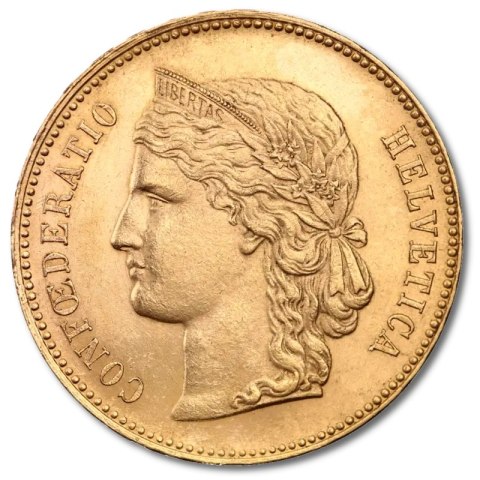
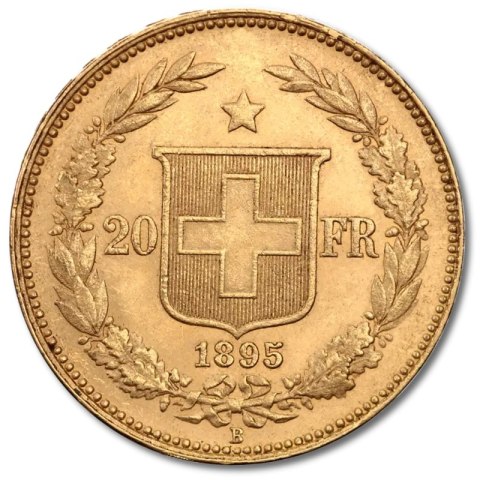
20 Swiss Francs Helvetia (1883-1896) — the direct predecessor of Vreneli with the Helvetia motif by Antoine Bovy
The 20 Swiss Francs Helvetia (1883-1896) gold coin is a historic Swiss 20-franc piece of the Latin Monetary Union (LMU) standard with a gross mass of 6.4516 g, a pure-gold mass of 5.80645 g, a 0.900 fineness (Crown-Gold-style alloy), a 21.0 mm diameter and a 20-Swiss-franc face value (CHF). The obverse features the bust of Helvetia — personification of the Swiss Confederation — with stars and an oak wreath, designed by Antoine Bovy. Struck at the Bern Mint (letter B) for 14 years (1883-1896), Helvetia is the direct predecessor of Vreneli — replaced in 1897 by the newer Fritz Ulysse Landry design. The lower mintage (approx. 4.2 million pieces over 14 years vs 58 million Vreneli over 52 years) gives Helvetia a higher collector value and a market markup of 5-10% over spot. VAT-exempt in the EU as a historic legal-tender coin with a 0.900 fineness.
Technical specification
| Parameter |
Value |
| Manufacturer |
Bern Mint (Switzerland, letter “B” on the coin) |
| Series |
20 Franken Helvetia — direct predecessor of Vreneli |
| Mintage years |
1883-1896 (14 years, mixed years on sale) |
| Standard |
Latin Monetary Union (LMU from 23.12.1865) |
| Gross mass |
6.4516 g (gold + copper) |
| Pure gold mass |
5.80645 g |
| Fineness |
0.900 fineness (Crown-Gold-style alloy) |
| Alloy |
Au 90% + Cu 10% |
| Diameter |
21.0 mm |
| Thickness |
approx. 1.3 mm |
| Face value |
20 Swiss francs (CHF, historic legal tender) |
| Obverse |
Helvetia — bust with stars and oak wreath, design by Antoine Bovy, HELVETIA |
| Reverse |
Swiss shield with Helvetic cross and olive branch/laurel wreath, 20 FR |
| LBMA status |
Not directly (historic coin, not a current bullion issue) |
| VAT in the EU |
Exempt (legal-tender coin, fineness 900 = minimum, struck after 1800, EU Directive 2006/112/EC Art. 344) |
| UK status |
NOT CGT-free (CGT exemption applies only to British legal tender) |
| USA status |
NOT IRA-eligible (IRS admits only American coins and selected bullion) |
| Packaging |
Protective capsule or blister |
Why Helvetia deserves a place in your portfolio
- Direct predecessor of Vreneli — historic rank of the coin: Helvetia (1883-1896) is the direct predecessor of Vreneli (1897-1949) — two consecutive issues of Swiss 20-franc coins struck at the same Bern Mint to the identical LMU standard. The replacement of Helvetia by Vreneli in 1897 resulted from a federal government competition for a newer image — the Antoine Bovy design gave way to the Fritz Ulysse Landry design. A collector set of both coins (Helvetia + Vreneli) presents the full history of Swiss LMU 20F coins from 1883-1949.
- Low mintage 4.2 million pieces in 14 years — higher collector value: Helvetia was struck in a total mintage of approx. 4.2 million pieces over 14 production years (1883-1896) — significantly lower mintage than Vreneli (58 million over 52 years). The lower supply on the secondary market explains Helvetia's higher market margin over spot (5-10% over spot vs 2-5% Vreneli) and the higher collector value of individual vintages.
- Antoine Bovy design — Swiss sculptural tradition of the 19th century: Antoine Bovy (1795-1877) was a Swiss sculptor and medallist born in Geneva, one of the most important Swiss Confederation coin designers of the 19th century. Bovy designed the Helvetia obverse in classicist style, with a woman's head representing Helvetia and an oak wreath — a composition inspired by ancient and Renaissance medals. The design was in force for 14 years, after which it was replaced by the more modern Vreneli image (Landry).
- Crown-Gold-style alloy 0.900 — LMU standard: The 900 fineness (Au 90% + Cu 10%) is identical to Vreneli, Napoleon III, Angel and Leopold II — all LMU 20F coins share identical technical specifications thanks to the 1865 LMU treaty. The alloy is harder than pure 999.9 gold, preserving the coins in good condition after 130-145 years of circulation.
- Helvetia as the rarer Swiss LMU 20F — portfolio complement: For collectors and buyers building a portfolio of historic LMU 20F coins, Helvetia is a desirable complement alongside Vreneli — two Swiss types from different periods (19th century Bovy vs turn of 19th/20th century Landry), with different compositional motifs (static bust vs portrait against Alps). The higher 5-10% markup is a trade-off for rarity and collector value.
History of Helvetia and the LMU context for Switzerland
Switzerland joined the Latin Monetary Union as one of the four founding states by the treaty of 23 December 1865 — alongside France, Belgium and Italy. The LMU 20F standard (6.4516 g gross, 0.900 fineness, 5.80645 g pure gold) was adopted for the Swiss 20-franc coin without modification — Switzerland accepted the French pattern mathematically derived from the germinal franc. The first Swiss 20-franc coins, however, appeared only in 1883 — with an 18-year delay relative to the LMU treaty.
The delay resulted from discussions about the obverse motif — for 18 years (1865-1883) the Swiss Confederation did not strike its own 20-franc coins in gold, relying on the inflow of French Napoleon III and Angel coins (full LMU interchangeability). Only after the stabilisation of the federal system in the 1870s and the consolidation of the Bern Mint did the federal government commission Antoine Bovy to design the first Swiss 20-franc coin. Helvetia entered production in 1883 — with delay but in full LMU standard.
Antoine Bovy (1795-1877) — Swiss sculptor and medallist from Geneva — was a student of French classicist sculptors of the Napoleonic period. Over his career he designed hundreds of medals and coins, including Swiss Confederation coins (5-franc silver, 10-franc gold commemorative) and medals for French railways and financial institutions. The 20-franc Helvetia was Bovy's last great design — when the coin entered production in 1883, Bovy had already been dead for 6 years (he died in 1877), so the design was realised posthumously based on preserved studies.
In 1894-1895 the Swiss federal government announced a competition for a new 20-franc image — justified by the fact that the Bovy design was considered stylistically outdated (classicist, static) and not corresponding to the modern aesthetic of the late 19th century. The competition was won by Fritz Ulysse Landry from Neuchâtel with the Vreneli design — a more dynamic woman's portrait against the alpine background. Helvetia was withdrawn from production in 1896, and from 1897 the Bern Mint strikes Vreneli — the 14-year Helvetia period ended.
After withdrawal from production Helvetia remained in circulation as historic legal tender — Switzerland has never demonetised the LMU 20-franc coins (Helvetia and Vreneli) and both coins retain historic legal-tender status to this day (although in practice no longer used in everyday trade). Some Helvetia specimens were melted in crisis periods (World War I, crisis 1929-1933) for the production of central bank reserves, which reduced the number of preserved specimens on the secondary market and raised the collector margin.
Obverse — Helvetia bust by Antoine Bovy
The obverse of the 20 Swiss Francs Helvetia features the bust of a woman representing Helvetia — personification of the Swiss Confederation. Helvetia is shown in left profile, with stars over her head (stars symbolising the cantons of Switzerland) and an oak wreath surrounding her hair. Above the portrait is the inscription HELVETIA — the Latin name of Switzerland used in numismatics. The composition is static, classicist — in contrast to the more dynamic Vreneli (with alpine background).
Antoine Bovy (1795-1877) — Swiss sculptor born in Geneva — designed Helvetia in classicist style inspired by ancient Roman medals and Renaissance medals of the Florentine Medici. Bovy was a student of French sculptors of the Napoleonic period (David d'Angers, James Pradier) and transferred French classicist aesthetics to Swiss numismatics. His designs are recognisable by static portraits, clear compositional lines and strict subordination to classical conventions.
The stars over Helvetia's head symbolise the cantons of the Swiss Confederation — in 1883 (year of the first issue) Switzerland counted 22 cantons (currently 26 after the separation of Jura in 1979). The number of stars on the coin is not exactly 22 — Bovy applied a stylistic arrangement rather than a literal rendering of the canton number. The oak wreath symbolises strength, durability and federal unity — a traditional attribute of Swiss cantonal heraldry.
Bovy's stylistics differ clearly from Landry (Vreneli) — Helvetia is a “goddess-woman” in antique style (static bust, idealised features), while Vreneli is a “realistic Swiss woman” (young woman with specific facial features, hair gathered in a braid, against the Alps). This stylistic difference is often analysed by numismatists as a reflection of the change in European aesthetics between the 1880s (classicism) and the turn of the 19th/20th century (Art Nouveau, realism).
Reverse — Swiss shield with Helvetic cross and olive branch
The reverse of the 20 Swiss Francs Helvetia features the Swiss shield with the white Helvetic cross in the centre, surrounded by a laurel wreath or olive branch (depending on iconographic interpretation). Around the shield is the inscription 20 FR (face-value designation in Swiss francs) and the year of minting below the shield. The mint letter “B” (Bern, Bern Mint) is placed on the reverse next to the year — identical standard to Vreneli.
The Helvetic cross (Schweizerkreuz) — a white Greek cross with equal arms — has been the national emblem of Switzerland since 1815. The shield with cross on the Helvetia coin is identical to the shield on the Vreneli coin — the Bern Mint retained the same reverse motif despite the obverse change in 1897. The reverse continuity reflects the stability of Swiss state symbolism (national emblem unchanged since 1815) — in contrast to France, where regime changes (empire republic) resulted in reverse motif changes (eagle rooster).
The olive branch surrounding the shield (or a laurel wreath in some issues) symbolises peace and neutrality — key values of Swiss foreign policy since the 17th century. Switzerland was neutral in both world wars of the 20th century (despite being geographically surrounded by warring states) and retained this position to this day. The olive branch is a traditional symbol of peace in European heraldry — it also appears on coins of ancient Greece (Athens: olive as an attribute of Athena) and the Renaissance (Venice, Florence).
The year of minting placed under the shield serves as the distinguishing feature between issues in the 14-year Helvetia series (1883-1896). The most common vintages are the years 1886-1894 (highest mintages). The rarest are early issues (1883-1885 — first production years, low mintages) and the last vintage 1896 (year before the introduction of Vreneli, low mintage). These issues may have numismatic value significantly higher than the precious-metal value — typically +30-50% over mixed years.
What to look out for when buying
Check the vintage of the Helvetia coin — in secondary trade, mixed years contains various vintages 1883-1896. Specific collector vintages (1883-1885 — first production years; 1896 — last year before Vreneli) may be sold with a numismatic markup of +30-50% over mixed years. For a buying strategy, mixed years are optimal — lower unit cost while maintaining full gold content (5.80645 g identical in all vintages).
The market markup over spot on Helvetia typically holds in the range of 5-10% over spot — higher than Vreneli (2-5%), Napoleon III and Angel (3-6%) and Leopold II (4-8%). The higher margin results from the lower mintage (4.2 million pieces vs 58 million Vreneli) and the higher collector value. Helvetia is the “rarer” Swiss LMU 20F — which makes it more sought-after collector-wise but at the same time more expensive in metal content.
Check the mint of striking — all Helvetia coins are struck at the Bern Mint (letter “B” on the reverse next to the year). The absence of the letter “B” or another mint letter most likely indicates a counterfeit. The Bern Mint — Eidgenössische Münzstätte — has been the only official Swiss Confederation mint since 1855, striking federal coins continuously.
Check the condition of the coin and authenticity — Helvetia in the 900/1000 alloy retains typical circulation traces after 130-145 years: light wear, fine scratches, natural surface patina. Pay particular attention to the preservation of obverse details — the stars over Helvetia's head and the oak wreath are fine elements prone to wear. For a buying strategy, VF and EF grades are acceptable. Each coin is delivered in a protective capsule or individual blister.
Why GoldInvest24
- Full cross-section of historic LMU 20-franc coins: in our catalogue you will find all the key LMU 20F issues — Vreneli (Switzerland), Napoleon III (France), Angel of the Third Republic (France), Helvetia (Switzerland) and Leopold II (Belgium).
- Mixed years for optimal margin: Helvetia offer in mixed-years format (various vintages 1883-1896) with a 5-10% markup over spot — higher than Vreneli, but justified by lower mintage and higher collector value.
- PL / DE / EN language versions: full technical descriptions in three languages for convenient service of the Polish, German and international markets.
- Current precious-metals quotes: spot data for comparing offer prices with current market valuation — check the current precious-metals prices before purchase.
- Full precious-metal categories in one shop: access to gold bullion coins, bars, silver, platinum and palladium — all from a single customer account.
Comparison of 5 coins — Vreneli, Napoleon III, Angel, Helvetia, Leopold II
| Feature |
Vreneli (CH) |
Napoleon III (FR) |
Angel (FR) |
Helvetia (CH) |
Leopold II (BE) |
| Mintage years |
1897-1949 |
1853-1870 |
1871-1898 |
1883-1896 |
1867-1882 |
| Mint |
Bern |
Monnaie de Paris |
Monnaie de Paris |
Bern |
Brussels Mint |
| Obverse |
Helvetia (Vreneli) |
Napoleon III |
Genius of Liberty |
Helvetia seated |
Leopold II |
| Designer |
Fritz Ulysse Landry |
Barre / Hugues |
Augustin Dupré |
Antoine Bovy |
Léopold Wiener |
| Pure gold |
5.80645 g |
5.80645 g |
5.80645 g |
5.80645 g |
5.80645 g |
| Fineness |
0.900 |
0.900 |
0.900 |
0.900 |
0.900 |
| Typical margin over spot |
2-5% |
3-6% |
3-6% |
5-10% |
4-8% |
| Secondary liquidity |
Highest |
Very high |
High |
Medium |
High |
See the entire gold bullion coins category available at GoldInvest24.
FAQ — common questions about the 20 Swiss Francs Helvetia
What is the 20 Swiss Francs Helvetia?
The 20 Swiss Francs Helvetia is a historic Swiss gold coin of the Latin Monetary Union standard, struck at the Bern Mint in 1883-1896 with a gross mass of 6.4516 g, a pure-gold mass of 5.80645 g, a 0.900 fineness and a 21.0 mm diameter. The obverse features the bust of Helvetia with stars and an oak wreath, designed by Antoine Bovy. Direct predecessor of Vreneli (1897-1949) — replaced in 1897 by the Landry design.
What is the technical specification of Helvetia?
Gross mass 6.4516 g, pure-gold mass 5.80645 g, 0.900 fineness (Au 90% + Cu 10%), 21.0 mm diameter, approx. 1.3 mm thickness, face value 20 Swiss francs. Mint: Bern (B). Obverse: Helvetia bust with stars and oak wreath (Bovy). Reverse: Swiss shield with Helvetic cross and olive branch, 20 FR.
What is the history of Helvetia and the LMU context?
Switzerland joined the LMU on 23.12.1865 as a founding member. The first Swiss 20F appeared only in 1883 — 18-year delay due to discussions about the obverse motif. Helvetia was struck in a total mintage of approx. 4.2 million pieces over 14 years. Replaced in 1897 by Vreneli after a federal government competition (1894-1895), won by the Landry design.
How does Helvetia differ from Vreneli, Napoleon III, Angel and Leopold II?
Helvetia (CH, 1883-1896) — direct predecessor of Vreneli (Bovy), lower mintages (4.2 million vs 58 million Vreneli), higher markup 5-10%, classicist style. Vreneli (CH, 1897-1949) — successor of Helvetia (Landry). Napoleon III (FR, 1853-1870). Angel (FR, 1871-1898). Leopold II (BE, 1867-1882).
For whom is Helvetia a practical choice?
For collectors of historic gold coins due to lower mintages and higher collector value than Vreneli, for building a complete portfolio of Swiss LMU 20F (Helvetia + Vreneli present the full history 1883-1949), and for buyers accepting a higher initial margin (5-10%) in exchange for the chance of a long-term collector value increase.
What is the LBMA, VAT, CGT and IRA status of Helvetia?
LBMA Good Delivery — NOT directly (historic coin). VAT in the EU — EXEMPT (historic legal tender, 0.900 fineness, struck after 1800, ≤180% gold value — EU Directive 2006/112/EC Art. 344). CGT-free in UK — NO (only British legal tender). IRA-eligible in USA — NO.
How do I buy the 20 Swiss Francs Helvetia at GoldInvest24?
Place an order in our shop with access to the gold bullion coins category, the full range of historic LMU 20-franc coins (Vreneli, Napoleon III, Angel, Helvetia, Leopold II). Check the current gold quotes. Descriptions in PL / DE / EN.
![[{[item.product.name]}]]([{[item.product.photo.url]}] 75w)