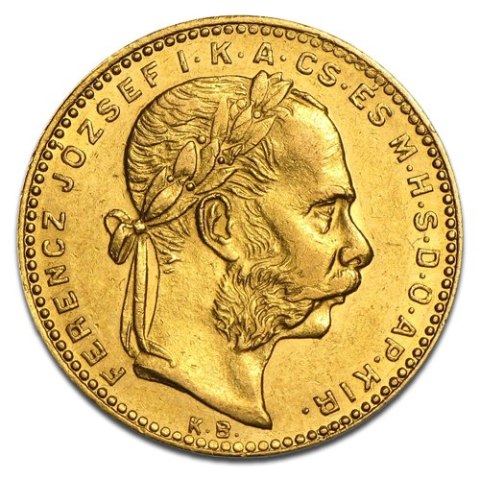
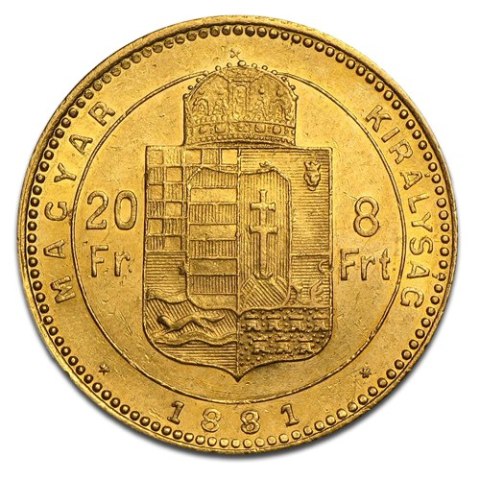
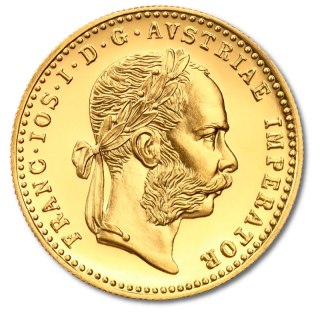
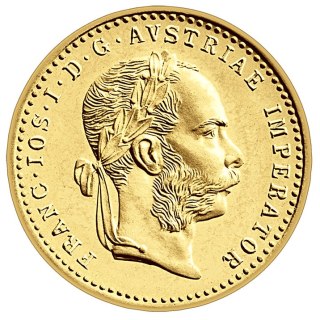
8 Forint / 20 Francs Hungary — the 20 franc standard
This coin was struck to the 20 franc standard: 6.4516 g gross at 900 fineness, giving 5.806 g of pure gold in a coin 21 mm across. Four countries — France, Belgium, Italy and Switzerland — formalised that standard in the Latin Monetary Union of 1865, and Austria-Hungary matched it with its 8 florin and 8 forint pieces.
The Hungarian 8 forint carried the same specification as the Austrian 8 florin and the French 20 francs — one standard, three denominations, three languages on the coins.
Specifications
| Property |
Value |
| Metal |
Gold, alloyed |
| Fineness |
900 |
| Gross weight |
6.4516 g |
| Fine gold |
5.806 g |
| Diameter |
21 mm |
| Country |
Hungary (Austria-Hungary) |
| Ruler |
Franz Joseph I |
| Period |
1870-1892 |
Why these coins are interchangeable
The whole point of the standard was that a 20 franc coin from Paris, Brussels, Bern, Rome or Vienna held the same gold and could be spent anywhere in the union. More than a century later that still matters: these coins trade on gold content rather than nationality, which is why the market treats them as one class and prices them accordingly.
Because they were circulation coins, condition varies. Wear reduces collector value but not the gold content, which is what most buyers of this class are paying for.
VAT and UK capital gains tax
HMRC treats a coin minted after 1800 as investment gold if it is at least 900 thousandths fine, is or has been legal tender in its country of origin, and normally sells at no more than 180 per cent of the open market value of its gold (VAT Notice 701/21A). At exactly 900 this coin meets the purity test, and it was legal tender in its day, so it falls inside the exemption for investment gold.
Capital gains tax is separate: the UK exemption follows sterling legal tender, so it covers Sovereigns and Britannias but not a continental coin. This is the published rule, not tax advice — your own position depends on your circumstances.
Questions buyers ask
How much gold is actually in it? 5.806 g. The coin weighs 6.4516 g because it is 900 fine rather than pure.
Does the country make a difference to the price? Very little. These coins are priced on gold content; the premium differences between issuing countries are small.
Is it VAT free in the UK? At exactly 900 fine it meets HMRC's purity test for investment gold, and it was legal tender when issued.
Will it be worn? These circulated. Expect handling marks; the gold content is unaffected.
Other historical coins are on the historical gold coins page. Live quotes on the precious metals prices page.
![[{[item.product.name]}]]([{[item.product.photo.url]}] 75w)